Private infrastructure investments have demonstrated remarkable overperformance and resilience amid recent global crises — from the pandemic to inflation and energy shocks.
According to research by Invest Europe, European infrastructure funds yielded a net IRR of 9.0% since inception, with a TVPI of 1.56x, both ahead of the MSCI Europe Infrastructure index performance of 4.30% and 1.22x. Over long periods from five years up to 20 years, European infrastructure funds returned consistently between high single-digits and low double-digits.
Anchored by long-term contracts, a focus on essential services, and inflation protection, an analysis of a sample investor mandate shows that infrastructure portfolios have consistently delivered stable performance and remained resilient over time.
Beginning in 2012, the infrastructure portfolio initially focused on renewable energy in Europe. This reflected the early maturity of the sector and the investor’s appetite for stable, long-term cash flows. As the global infrastructure market expanded, so did the mandate. Over the years, the portfolio evolved into a globally diversified strategy, encompassing renewable energy, communication, transport, and utilities through primary and secondary funds, co-investments, and direct investments:
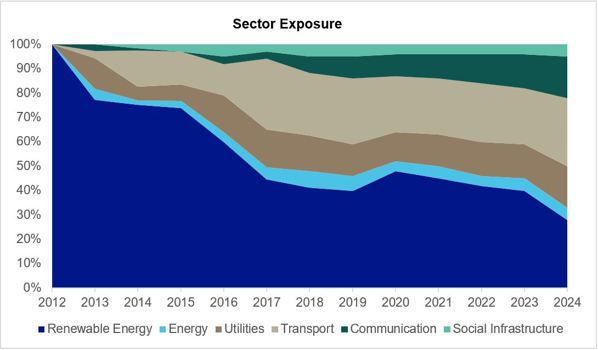
This evolution mirrors the broader trajectory of the market. The global value of private infrastructure assets has surged by more than 1,231% since 2009, reaching USD 1.22 trillion by the end of 2024.
Today’s portfolio reflects this maturity, balancing energy transition assets with digital infrastructure, regulated utilities, and transport networks. Such diversification not only enhances risk-adjusted returns but also aligns with the investor’s focus on long-term stability, steady cash yield, inflation protection, and sustainable impact.
The strength of a diversified strategy became especially evident during recent global disruptions. Despite the volatility caused by the pandemic,the war in Ukraine, rising inflation, and the energy crisis, the portfolio continued to deliver robust performance and stable cash flows. Each sector contributed differently to this resilience: renewable energy for example benefited from long-term fixed-price contracts, communication infrastructure saw increased demand due to digitalization, and transport assets recovered steadily post-lockdowns.
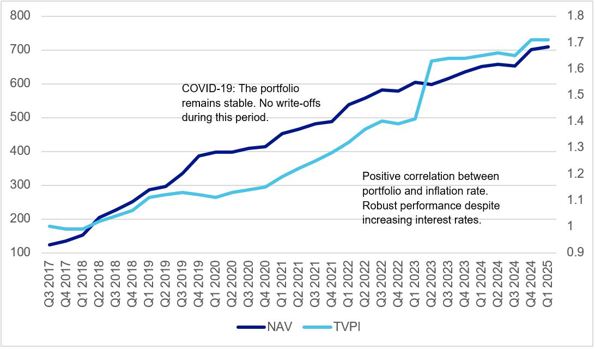
This graph shows an extract from the overall timeline.
Throughout these events, the portfolio’s low correlation with public markets and its inflation-linked revenues helped preserve value. Operational assets continued to generate predictable income, while prudent asset selection and geographic diversification reduced exposure to single-market shocks.
Performance metrics underscore this stability, with a portfolio TVPI of 1,7x and an IRR of more than 13% over the period shown. While the shown IRR already reflects strong performance, it is worth noting that the portfolio has been continuously investing over time. Additionally, the portfolio has generated a consistent average high single-digit cash yield.
Infrastructure has proven to be a resilient cornerstone of long-term investment strategies. By evolving in line with market developments and expanding sector exposure, a well-structured portfolio can withstand economic shocks while delivering consistent performance. As recent crises have shown, infrastructure’s essential nature, inflation protection, and low market correlation make it a reliable choice for investors seeking durability and value across cycles.
Toni Quittschalle
Managing Director, Palladio Partners
Clemens Rektor
Investment Manager, Palladio Partners
Want to discuss?
We are always keen to hear from you.