Quiet Power

For 80 years, Europe has built peace and prosperity through cooperation.
The result: a sizeable, stable economy powered by public and private capital. Today, Europe is the world’s second-largest economic area.
Europe's strengths at a glance
19
of world's top 50 banks
81.5%
debt-to-GDP vs 125% in the US
3
of the world's most traded currencies
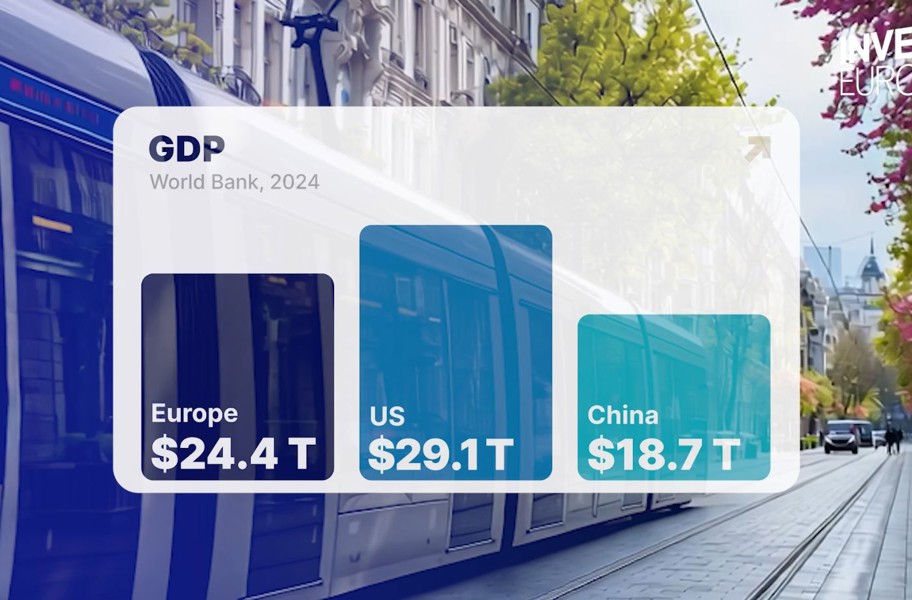
Europe's inherent advantage
Europe consistently ranks among the world’s best for innovation, competitiveness, and business environment:
Europe’s ecosystem creates unmissable opportunities for investors: from cutting-edge tech and scientific ventures to established market leaders with strong, defensible positions.
Europe's innovation nations
7
of the world’s top 10 most innovative countries (WIPO)
6
of the top 10 for competitiveness (IMD)
4
of the top 10 for ease of doing business (World Bank)
Momentum for the next decade
Europe attracts more than 5,000 new or expanded FDI projects each year, creating hundreds of thousands of jobs (EY). Yet the Draghi Report (2024) estimates that €800 billion is still needed in infrastructure and technology to remain globally competitive. Geopolitical shifts are driving Europe to strengthen sovereignty, protect its values, and invest in long-term strategic priorities.
Europe's Investment Ambitions
The role of private equity & venture capital
Public funding alone will not meet Europe’s strategic ambitions. Private equity and venture capital are central to unlocking growth, financing innovation, and building globally competitive companies across industries.
5%
(up to) of GDP on defence projects in NATO nations
€800bn
EU Defence-Readiness 2030 plan
€200bn
EU InvestAI initiative
€100bn
EU Clean Industrial Deal
€500bn
Germany’s climate & infrastructure fund
£725bn
UK 10-year infrastructure strategy
Private equity and venture capital: powering growth, jobs, and returns
Private equity and venture capital: outstanding returns, essential investments
€1.25tn
under management at end-2024 → 2.6x growth over the last decade
17%
net IRR since inception for European mid-market → TVPI of 1.81x
18.95%
0-year return for European VC → proving a maturing ecosystem

The Performance of European Private Equity
European private equity and venture capital form a mature yet dynamic ecosystem. They finance tens of thousands of companies, employ millions, and generate superior returns for investors, from global institutions to European pensioners and savers.
Private capital: a cornerstone of Europe’s economy
11.2m
people employed by PE and VC-backed companies → 5% of Europe’s workforce, more than the population of Portugal or Greece
339,149
jobs created in 2024 → +5% YoY, outpacing overall European job growth for the sixth year in a row
€126bn
invested in 8,353 companies in 2024
Expanding opportunity
Private capital provides more than funding. Experienced managers bring expertise, networks, and operational excellence, helping start-ups, SMEs, and mid-sized companies grow stronger and more resilient. As public markets shrink – with listed companies on the London Stock Exchange down 31% since 2015 – private markets are expanding, offering investors unique access to Europe’s most dynamic businesses.
€126bn
invested in 8,353 companies in 2024
€414bn
dry powder ready to support tech & biotech innovators, SMEs, and established businesses
28,610
European companies backed by PE/VC at end-2024
Room to grow
Private capital is essential to thriving economies, but the opportunity in Europe is still vast.
Unlocking more private capital would accelerate growth, boost job creation, innovation, and competitiveness across Europe.
6.6%
of European GDP contributed by PE/VC-backed businesses – vs 12.4% in the US

Why foreign investors matter
Europe cannot fuel its growth with domestic money alone. In 2024, 32.3% of capital raised by European private equity came from outside the continent. Without it, Europe risks underfunding the climate transition, digital innovation, defence, and infrastructure.

The fix: clearer, faster, more open
To attract more global capital, Europe must make investment simpler and more predictable:
Clarify rules so passive investors in funds aren’t treated as decision-makers.
Streamline screening with a single EU-wide system instead of fragmented national regimes.
Create a One-Stop Shop for cross-border investment approvals.

The ambition: by 2029
Europe should not just maintain today’s levels of foreign investment: it should grow them. That means turning Europe from a regulatory citadel into a global investment magnet.