
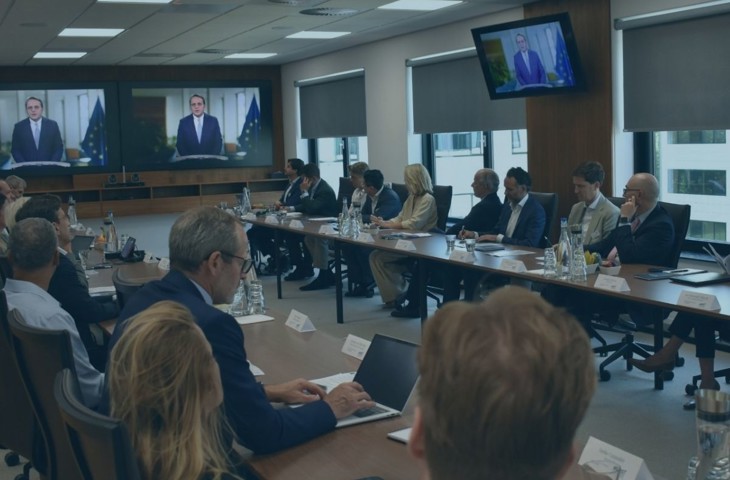
This week in Brussels, we hosted, in partnership with MEP Stine Bosse, a roundtable discussion, as part of the Investment for a competitive and sustainable EU Intergroup, on a question that sits at the heart of Europe’s competitiveness agenda: how do we finance the journey from ambition to scale in biotech and life sciences?
At the event, we brought together key voices from across the ecosystem from Thomas Van Cangh, Head of the Biotech Task Force at the European Commission's DG SANTE, to public investors from the EIB Group, including Cindy Daniel (EIF) and Antoine de Lachaux (EIB), and leading private investors - and members of Invest Europe - including Naveed Siddiqi (Novo Holdings) and Edward van Wezel (BGV), all moderated by our very own Martin Bresson.
Several messages were echoed throughout the panel. Europe continues to produce world-class science, talent and breakthrough companies. The issue is not a lack of innovation or investable companies, but a structural one: Europe still lacks the depth of capital, the right market conditions, and the regulatory environment necessary to allow biotech companies to scale at home. Fragmentation across Member States continues to create unnecessary friction, delay development, and push companies, capital, talent and growth to look elsewhere.
And this matters far beyond the sector itself. Biotech and life sciences are part of the foundation of Europe’s prosperity, health resilience and long-term competitiveness. Fewer medicines launched in Europe means not only companies relocating or being financed elsewhere, but also missed opportunities for patients, for public health systems, and for Europe’s economic future.
What needs to change?
We need a true single market for clinical trials. Better sector-specific policy and more harmonised clinical trial frameworks would make a real difference in investor confidence and company location decisions.
We need to mobilise larger pools of private capital, especially from institutional investors such as pension funds. Europe has companies worth backing, unlocking more long-term capital remains one of the central missing pieces, as private equity and venture capital are indispensable to the ecosystem. Private investors do not only provide capital, they also bring commercial discipline, strategic expertise and the operational support needed to turn scientific excellence into viable companies. In that sense, private capital is the glue between innovation and impact.
We need public and private funding work better together. Public funding is and should continue to play a substantial role in the ecosystem, because private capital cannot operate in a vacuum, particularly in this sector, where timelines are long, risk is unusually high and failure rates are significant. Different financing solutions help companies move through the full innovation lifecycle. Public funding is especially an anchor for private capital, a seal of approval, and a mechanism to attract additional investors into a market that is still too shallow in many areas.
We need an ecosystem approach. The financing challenge is most acute at the earliest stages, where technologies and companies are still emerging, but it is equally, if not more, severe later on, when European companies need larger rounds to scale, grow internationally and move towards IPO or exit. Financing should be continuous across the full company lifecycle. That includes strengthening Europe’s public markets and broader efforts linked to the Savings and Investment Union, so that innovative companies have credible pathways to remain and grow in Europe, including through listing.
We need a shift in perspective. Looking at markets country by country often underestimates both patient need and opportunity. A more integrated European approach, including stronger recognition of clusters, is essential to unlock scale.
There are many other enablers, from incentives, to procurement and pricing models, to support for innovation in areas such as rare diseases, and addressing skills gaps across the value chain, but one point is clear: the time to act is now.
The good news is that the building blocks are there. Excellent science, committed investors, engaged EU institutions, and a growing recognition that biotech and life sciences are strategic sectors for Europe, including through the ongoing European Biotech Act I, which is a strong and necessary signal that Europe is serious about creating a more investable biotech and life sciences ecosystem. Now those building blocks need to be matched by capital and market design.
There was a lot of realism in the room, but also optimism. Europe has what it takes. Now it needs to move faster, think bigger, and create the right conditions for companies to scale.
At Invest Europe, we were proud to bring together in one room the perspectives of policymakers, public institutions, private investors, companies, clusters, and patients, all around a common objective: building a European biotech and life sciences ecosystem that is truly worth investing in, and capable of delivering for patients, companies and Europe’s future.
Related

Invest Europe recognised as key reference point in European Biotech Act I monitoring and evaluation framework
News
11 Jun 2026

The European Life Sciences Coalition (ELSC) landing page and video launch
News
05 Jun 2026

European Life Sciences Coalition launched to strengthen Europe’s life sciences investment ecosystem
News
12 Feb 2026





Europe’s Choice: The value of investing in innovation
External events
23 Jun 2026

MEMBER ONLY
How innovation drives health and growth in Europe: Assessing the Return on Investment of innovative medicines
External resources
23 Jun 2026

The European Life Sciences Coalition (ELSC): Empowering the next generation of life-saving breakthroughs (Video)
Videos
05 Jun 2026





VC Success in European Biotech & Healthcare
Data and insight
06 Oct 2025

Response to the European Commission Call for Evidence on the European Biotech Act
Positions & consultation responses
06 Jun 2025

European biotech and life sciences: the need for sustained investment and a structured financial ecosystem
Opinion
10 Mar 2025


