
It’s a question that is often raised, by media and external stakeholders alike: should private capital play a role in an essential public service like healthcare?
Life-changing and -saving investments in healthcare
The reality is that private equity and venture capital are already playing a growing role in strengthening Europe’s healthcare systems, investing €135 billion in European healthcare between 2008 and 2024 and €12.7 billion in 2024 alone, more than double the €5.7 billion invested in 2016.
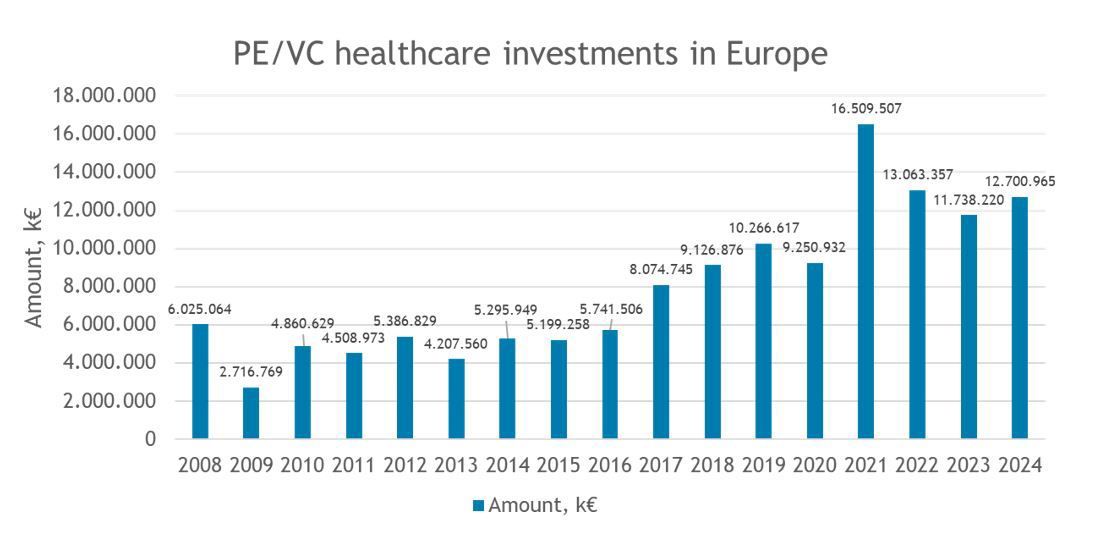
Source: Invest Europe
This sustained flow of capital is essential as Europe faces ageing populations, rising demand for preventive medicine, and increasing pressure on public budgets, with private investment already accounting for 4.4% of total healthcare expenditure across European countries in 2020.
Evidence shows that private equity ownership can enhance efficiency and quality in certain segments, particularly outpatient care, helping Europe meet growing healthcare needs while improving the patient experience.
Similarly, research on 45 hospital leveraged buyouts in the United States shows that when a private equity firm acquires a hospital, financial performance improves without any deterioration in clinical outcomes. In fact, the study found that patients admitted for heart attacks received better-quality care, evidenced by lower all-cause mortality within 30 days of admission.
Two recent examples from Invest Europe members Forbion and Enterprise Investors reveal that mid-market private equity (MM) and venture capital (VC) form a powerful continuum: VC drives breakthrough science while MM scales essential services where patients need them most.
Venture capital: rare diseases and biomedical progress
Invest Europe’s report VC at the Heart of Life Sciences shows how dramatically venture capital has scaled Europe’s biotech and healthcare innovation.
VC investment in the sector has more than tripled over the past decade, with €13.5 billion deployed between 2017 and 2021 across 2,634 biotech and healthcare venture-stage companies, representing 23% of all European VC activity.
This surge in financing has helped build a robust industry that is both scientifically dynamic and economically significant: VC-backed European biotech and healthcare companies employed 56,867 people in 2020, marking a 20% increase in just one year.
This growing capacity is also reshaping some of the most challenging areas of medicine, including rare diseases.
Rare diseases affect 300 million people worldwide, with 8,000+ genetic conditions and no approved therapy for over 90%. Once seen as commercially unviable, they are now central to precision medicine thanks to sustained specialist investment.

has made rare diseases a core strategy. Around 30% of its historical investments target rare or orphan indications, supported by €5 billion AUM and 8+ dedicated rare-disease companies. Former portfolio companies have achieved four FDA-approved gene therapies — HEMGENIX, Zynteglo, Lyfgenia and Skysona.
Forbion’s model blends capital with ecosystem building:
€2 million– €5 million per company for natural-history and real-world-evidence studies.
Early patient-community involvement to strengthen trial execution.
Company creation and spinouts translating academic breakthroughs into viable platforms.
Companies from its portfolio illustrates this breadth: Azafaros (lysosomal disorders), VectorY (CNS gene therapy), Dyne Therapeutics (neuromuscular disorders), Beacon Therapeutics (retinal gene therapy), AIRNA (RNA editing), RyCarma (RyR1-myopathies) and Prilenia (Huntington’s disease and ALS).
The common thread: platform technologies, rigorous clinical strategy, and capital stewardship geared toward high-impact science and long-term value creation. Rare-disease innovation is no longer peripheral. It is becoming a core engine for advances that later scale across broader therapeutic areas.
Mid-market private equity: expanding access to life-saving care
While VC operates at the molecular frontier, Europe’s MM transforms care delivery on the ground.
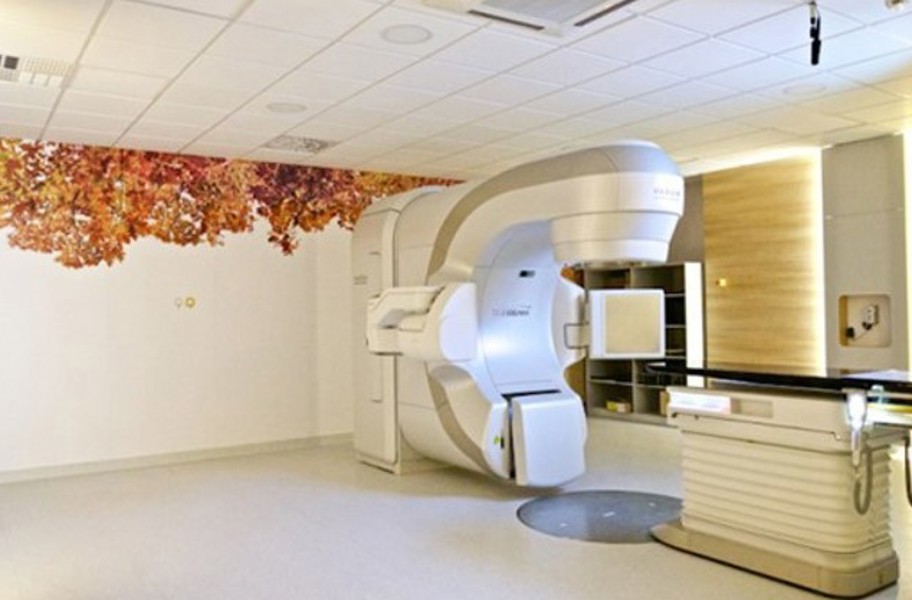
Enterprise Investors’ investment in Nu-Med Grupa is a clear example. Over the investment period, Nu-Med:
Provided cancer treatment to nearly 70,000 patients, mostly in underserved communities and smaller towns lacking radiotherapy access
Delivered 7,700 radiotherapy procedures in 2023 alone
Treated 600+ brachytherapy patients
Ran preventive screenings detecting cancers earlier
Supported thousands annually through the NU-MED Foundation
Nu-Med also offered group transport to reduce travel burdens, used by 832 patients in 2023, saving 11,400 km of car travel. Between July 2022 and June 2023, it opened three new outpatient facilities, bringing diagnostics closer to home.
Enterprise Investors is applying the same logic to Unity Care, consolidating and professionalising primary care in Poland’s smaller and ageing communities through rotating specialists and on-site diagnostics.
Doing good while doing well
The above examples by Forbion and Enterprise Investors illustrate the positive contributions private capital brings to healthcare:
VC accelerates frontier innovation (gene therapy, RNA editing, etc.)
MM scales essential healthcare infrastructure and raises standards where public systems struggle
Both share three defining strengths: long-term orientation, operational expertise and tangible social impact.
Investments like this show how MM and VC can identify underserved markets, scale innovation, and ultimately improve patient outcomes, all while being financially performant for the ultimate benefit of savers and pensioners.
In healthcare, like elsewhere, private equity and venture capital seek to do good while doing well.
Want to discuss?
We are always keen to hear from you.
Related


A message to European leaders from Europe’s Life Sciences investment and innovation community
Other publications
26 Jun 2026

European Life Sciences Roundtable: Advancing Europe's Biotech Competitiveness
News
25 Jun 2026

Europe’s Choice: The value of investing in innovation
External events
23 Jun 2026

MEMBER ONLY
How innovation drives health and growth in Europe: Assessing the Return on Investment of innovative medicines
External resources
23 Jun 2026

Invest Europe recognised as key reference point in European Biotech Act I monitoring and evaluation framework
News
11 Jun 2026

The European Life Sciences Coalition (ELSC): Empowering the next generation of life-saving breakthroughs (Video)
Videos
05 Jun 2026





VC Success in European Biotech & Healthcare
Data and insight
06 Oct 2025

Response to the European Commission Call for Evidence on the European Biotech Act
Positions & consultation responses
06 Jun 2025

European biotech and life sciences: the need for sustained investment and a structured financial ecosystem
Opinion
10 Mar 2025


