On March 6 at the EIB Group Forum in Luxembourg, Eric de Montgolfier - CEO, Invest Europe - participated in the panel "Frontier Technologies in Food, Biotech, and Life Sciences." The discussion focused on how Europe can scale innovation and reinforce its financial ecosystem to maintain leadership in these critical industries.
The key message delivered: Europe has a strong foundation in biotech, food, and life sciences, but without sustained investment and a structured financial ecosystem, we risk falling behind.
Below we have elaborated a bit on the points made with our data which highlights key trends in the funding landscape for biotech and life sciences venture capital.
Early-stage venture funds are struggling to raise capital compared to later-stage funds
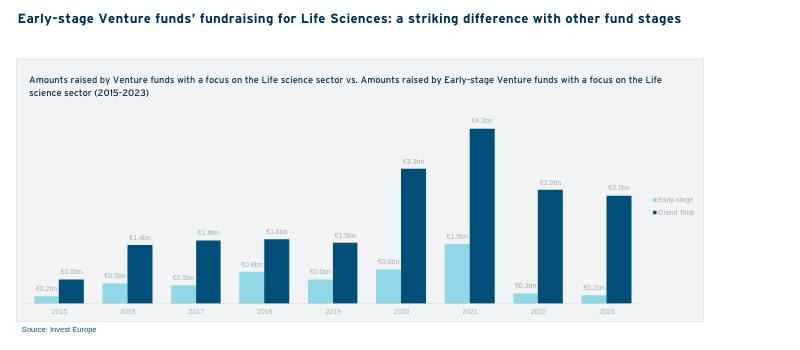
As this graph illustrates, the gap between total life sciences venture capital fundraising and early-stage venture capital fundraising is striking. Most of the capital is concentrated in later-stage funds, leaving early-stage funds with significantly less support.
Total amounts raised by early-stage funds have declined by 86.7% over the period 2021-2023. This creates a bottleneck in innovation - fewer early-stage startups financed today means fewer successful biotech and life sciences companies in the future. If this trend continues, Europe may see a slowdown in breakthrough innovations in this space, impacting future economic and scientific leadership.
Government funding is insufficient to offset private investment shortfalls
As shown in the graph below, the total amounts raised by venture funds have declined by 37% in the life sciences sector over the period 2021-2023, and in parallel government agencies' committed capital has declined by 63% over the same period, back to their level of… 2015.

This highlights a key concern: Private capital still – as it should - accounts for the vast majority of VC funding, but if private sector investment slows, public VC funding alone cannot sustain innovation. Without a more proactive and counter-cyclical approach, European life sciences may struggle to maintain global competitiveness.
Early-stage funds are using dry powder to offset fundraising challenges. This is not sustainable.
The last graph (below) reveals that early-stage investments have remained fairly stable despite tough fundraising conditions. However, this is not due to fresh capital inflows - instead, many venture funds are relying on their dry powder (previously raised but uninvested capital) to continue operations.
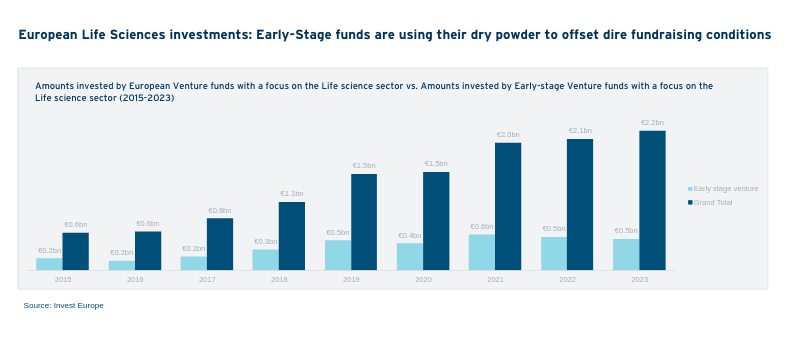
While this allows funds to keep investing in the short term, it is not a long-term solution. Once reserves run out, investment in early-stage life sciences startups could drop sharply, creating a funding crisis. The sector urgently needs new fundraising mechanisms before the dry powder is exhausted.
Conclusions
Europe has the talent, science, and ambition to lead in biotech, food, and life sciences - but we need the right investment structures to match. That means:
Smarter regulation that can make long-term innovation investment more attractive.
Targeted action to bridge funding gaps - public capital should help de-risk early-stage investments, while institutional investors must step up for scaling companies.
Better coordination across Europe - a harmonized framework could incentivize private investment across borders, ensuring capital flows where it’s needed most.
Aligning public funding with real market needs - redefining SME criteria to redirect public funding flows and prioritizing tax credits over slow, bureaucratic grants could accelerate biotech innovation.
Let us know what you think. How can Europe better support biotech and life sciences investment?
Want to discuss?
We are always keen to hear from you.
Related


New Invest Europe report highlights venture capital’s role in supporting pioneering European life sciences start-ups
Press releases
13 Oct 2022

Invest Europe Leader Interviews: Dr. Rafaèle Tordjman, Jeito Capital
Videos
26 Sep 2024

€143 billion invested in 10 years: VC drives European innovation
Press releases
25 Sep 2024