Current market practice

Understanding ESG is often not as the simple acronym implies, and so reporting it in a way that highlights an organisation’s successes and values can seem like a monumental process or insurmountable challenge. With so many frameworks, providers, and (increasingly) regulations demanding different information, those responsible for understanding, managing, and reporting on the ESG performance of an organisation (be it a private equity/venture capital firm or one of its portfolio companies) can become easily overwhelmed. In many ways this process is an idiosyncratic one, but by following the right process and breaking it down into manageable steps, you can alleviate a lot of the burden involved.
Instead of getting lost in the many broad, vague concepts and buzzwords, you should look to match together different ideas of ESG with the reality that your firm – and your portfolio companies – are facing, taking into consideration how they impact, and are impacted by, the three core pillars of ESG performance. These pillars are particularly relevant at underlying asset/portfolio asset level, but also at GP level.
Environmental performance centres around the physical, ecological impact of your organisation’s operations, i.e., what mark is your organisation leaving on the environment on a chemical, geological, and physical level (e.g., GHG emissions, waste management, water resources, and air pollution).
Social performance will include things like labour conditions, human rights, treatment of employees, and community engagement. It focuses on what sort of effect your operations have on the community around you, as well as the consumers you serve. Gathering information on this can prove difficult, since it will sometimes combine data from two different sites – that is, from the labourer and consumer side of things – which will generally be more difficult to collect in tandem with one another without a robust reporting system.
Lastly, there is the governance pillar – the pillar that has been around the longest, including things like business ethics and risk management. It focuses on how your organisation is structured and run, evaluating whether this is done in a modern, effective, and, to a certain extent, equitable way.
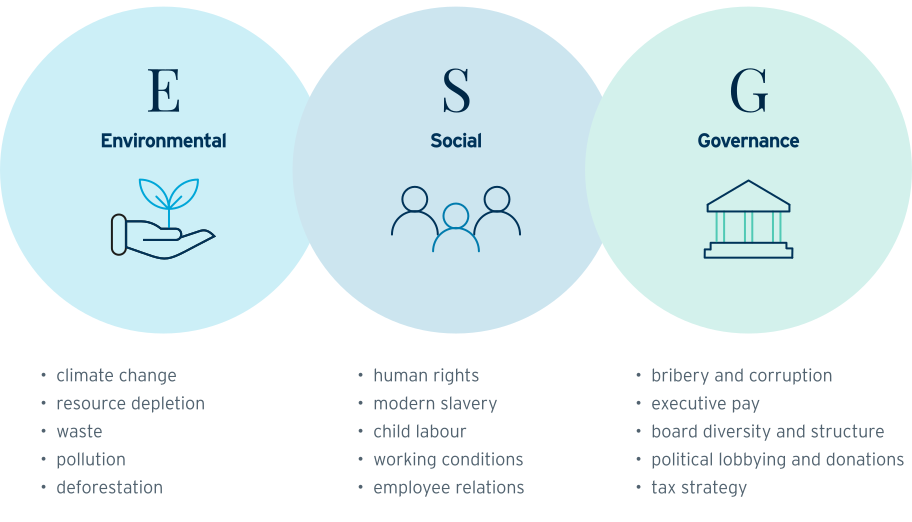
Figure 12: Examples of ESG issues (Source: Principles for Responsible Investment)
ESG performance will increasingly be a yardstick with which your firm will be measured against your peers. Embracing ESG is no longer a voluntary decision and should be considered sooner rather than later.
Sometimes it may be helpful to seek some ESG inspiration from other firms and to gather insights on how your peers are approaching things, regardless of whether it changes how you view ESG or simply affirms it. The results of a two-staged survey which Invest Europe undertook with its members in March and May/June 2022, three-quarters of whom were General Partners, are a good example of how – for the most part – the majority of PE/VC firms identify the same areas as relevant to their operations, and their portfolio companies, in some capacity.
In this section, you will find more detailed information on what your peers are doing around ESG performance and reporting, and what this means for the data collected.
Which topics do my peers consider important to collect data on?
Which frameworks and standards are my peers using?
Which ESG data providers are your peers using?
Which challenges do your peers face when collecting data?
Which topics do my peers consider important to collect data on?
Which frameworks and standards are my peers using?
Which ESG data providers are your peers using?
Which challenges do your peers face when collecting data?
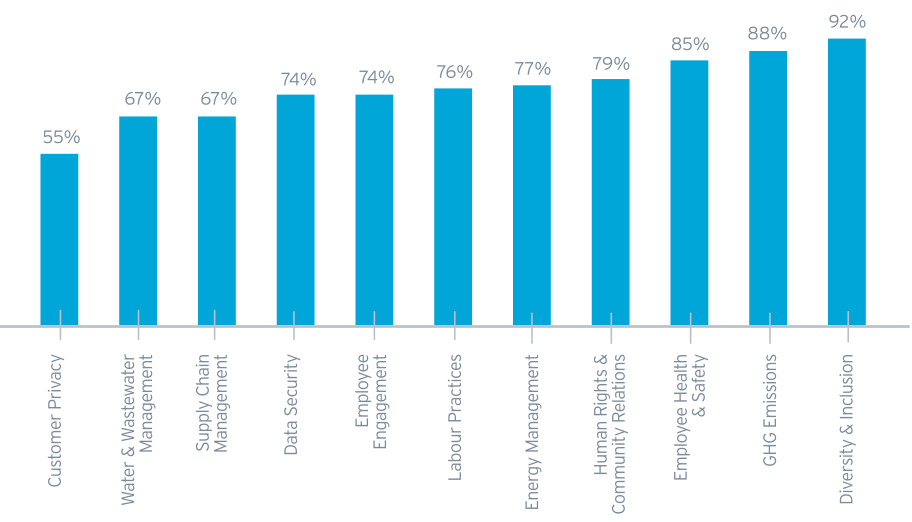
The bar chart below gives an overview of which ESG topics are most important to Invest Europe members when collecting data (according to the survey).
Every topic was important to more than half of respondents, and on average 76% considered a topic important to collect data on. Invest Europe members generally reported that they find it important to collect information on a wide range of ESG topics, with Diversity & Inclusion, GHG Emissions, and Employee Health & Safety at the top of the list. In that way, they cover their bases when disclosing ESG performance via frameworks or to rating agencies. As many organisations engage multiple rating agencies or frameworks to benchmark their ESG performance, it suits them to cover the widest range of data possible.
Of course, the specific metrics relevant to one organisation will generally be (slightly) different from those that its peers are collecting data on.
The chart below gives an overview of the frameworks, standards, initiatives, and regulations most familiar to, and most used by, the Invest Europe membership, according to the March and May/June 2022 surveys.
More specifically, the chart compares the percentage of Invest Europe survey respondents that were familiar with a framework with those who used a framework. It highlights the popularity of the TCFD, SASB, and EU SFDR frameworks, as well as identifying a few that, while known, are generally less commonly used.
Moreover, it draws attention to the fact that using multiple frameworks is common practice. Indeed, it seems like many firms have chosen to spread themselves across various frameworks and standards to disclose their ESG performance in a way that best suits each area that they feel is relevant and material to them and their portfolio companies. Since each framework will understand and measure each attribute differently, many firms prefer to pick and choose to show their ESG performance in a way that highlights their beliefs and values. Though ultimately there are certain metrics like Greenhouse Gas Emissions that appear more commonly across frameworks than areas such as Animal Care & Welfare, like so much of ESG disclosure, a lot comes down to the needs of an individual firm and its portfolio companies.
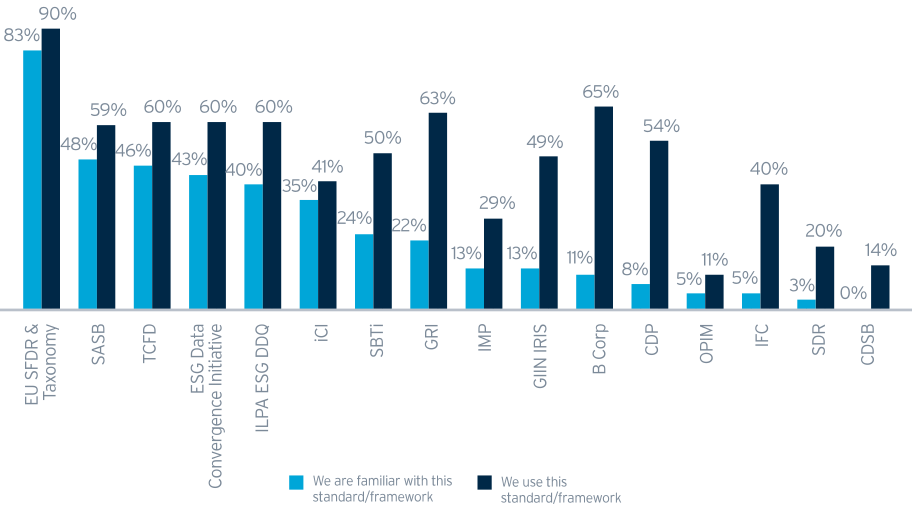
The most significant trend we see across this data is a current preference for frameworks like SASB, the EU Taxonomy and SFDR, and the ESG Data Convergence Initiative, all which have a broader scope when it comes to coverage of ESG metrics. This is in line with the conclusion in the previous question that Invest Europe members generally wanted to examine their ESG performance through as many different metrics and lenses as was possible, looking to collate as much data as they could.
Meanwhile, with the exception of the TCFD, most of the more specific, environmentally focused frameworks proved less popular at this point in time. This could be due to the fact that some GPs may not have got to grips yet with many of the nuances of climate.
An interesting outlier in these results is the climate focused TCFD framework, which has proven one of the most popular. This might be down to it becoming mandatory for certain organisations operating in the UK to work with from April 2022.
Generally, the results also underpin the idea that, going forward, adherence to regulations will be an important factor in determining which ESG frameworks are used, as well as suggesting that many organisations have made the decision in their ESG policy to be as ahead of the curve as possible, choosing to get acquainted with the EU Taxonomy and SFDR before the full regime becomes mandatory in 2023.
Building on the increased focus on ESG data by end investors, service providers are moving fast to ensure that they can meet the demand, as well as developing the market by adding new services. As a result, the marketplace for services around non-financial data is expanding rapidly. This allows for more options for companies to choose from, though of course raises the question of which provider is best for your organisation. Below we have outlined a few distinctions between various types of providers.
Data providers
Not all data providers offer the same services or have the same focus. The World Economic Forum prepared a comprehensive ESG Ecosystem Map, differentiating between:
- “Data Providers: Market” – Data providers that offer ESG research, data, and analytics as a subset of their broader product and service offerings for the financial services industry
- “Data Providers: ESG-Exclusive” – Providers with a particular focus on ESG research, data, and analytics
- “Data Providers: Specialised” – Providers focused on a specific ESG issue
ESG-specific rating providers
ESG-specific rating providers are often closely related to data providers in general, either being subsidiaries or a separate service within the same organisation. Of every ESG-related service, ESG rating providers are generally the best known, due at least in part to their being the most established service in ESG as a whole, with many of the largest players in this area having been involved with ESG in some way or another since the 1990s.
Between almost every rating provider there are different methodologies, metrics, weightings, and indicators that result in each one giving particular emphasis to certain aspects of ESG performance.
A lot of these established rating providers will sometimes also create their own frameworks, though it should be noted that many can be flexible in what they use to score ESG performance depending on the client. This addition of a more custom ranking of risk (be it material or systemic) – it is not uncommon among providers to factor it in – may make it difficult for an organisation interested in their services to fully grasp what they emphasise when scoring ESG performance.
Platform providers
In addition to data and rating providers, there are software platform providers that do not provide data as such, but a platform through which portfolio companies can report to fund managers and fund managers to their investors. There are quite a few ESG data collection technology platforms that have been purpose-built for private equity to assist GPs to collect and monitor ESG KPIs from their portfolio companies.
There are also platforms that focus on a subset of ESG, like carbon. For example, CDP offers a search tool for accredited solutions providers that focus on climate/carbon.
Platforms offer a degree of variety in their ever-expanding services. Generally, platforms can be categorised as follows, based on the nature of the services they provide:
- One prominent group is those platforms oriented around a full-service, end-to-end ESG solution, which guides clients through the difficulties of creating and adhering to an ESG policy, as well as then reporting their results to investors and through frameworks.
- Another group are the platforms that specialise in understanding the ESG risks and impacts of an organisation’s supply chain. By nature, supply chains contain a lot of moving parts and can involve an array of contractors and specialists that can be difficult to keep track of; and it is this issue that these platforms address. Generally, their model centres around providing a space for managers and investors alike to ask suppliers to enter any ESG-related data they want to collect, which can be easily supplemented by data gathered by surveys for a streamlined data collection experience.
- One final group to take note of is a small selection of firms whose coverage extends into monitoring public media and reporting on a client in order to understand how they are being viewed in the public eye and how any risks from this might be mitigated against, something that those operating in potentially divisive areas like Oil & Gas or Gambling might find more beneficial than most.
Sustainability indices
Even if you do not directly consider ESG rating providers, it is helpful to understand them and how they work because of the sustainability indices they support. That said, you should always take into account both the lack of applicability to private markets and the heavy use of public market proxies which effectively nullifies nuance of private markets.
A sustainability index is used to measure the responsibility of a certain company in social and environmental areas. The more companies that take these aspects into account as they develop their business, the higher the score they will obtain.
This practice is especially common with larger, more established firms, who offer their own sustainability indices; other firms have also begun partnering with ESG rating providers to create similar offerings. Some providers also offer custom indices, which allow clients the freedom to create a sustainability index that emphasises what they want from assets, rather than spending time trying to find a pre-existing index that does so.
Given the differences between providers and their indices, it may be helpful to understand what backs up many of the most prominent sustainability indices in the world. If, for example, an investor plans to use a specific sustainability index to help them make more sustainable investment decisions, as is the case with using frameworks, it is important to investigate how the methodology for scoring ESG performance differs from that of its peers and what emphasis this does or does not put on its ratings.
One of the questions in Invest Europe’s survey asked about which ESG data service providers members were using to collect the relevant data from managers (in the case of investors) and/or portfolio companies (in the case of both fund managers and investors). The results were inconclusive, with no single provider standing out as being the most used across the industry. In addition, no provider was identified by a majority of members as being particularly suitable for or adequate to support private equity and venture capital.
In addition, it seems like members sometimes use a number of service providers and tools, or indeed use their own solutions and templates, to improve their ESG reporting processes, with assessments being made and decisions taken on a case-by-case basis depending on members’ needs and expectations.
As a neutral representative of the private equity and venture capital industry, and considering that our surveys did not prove conclusive, we have decided not to name any specific providers. Different service providers serve different purposes, have different characteristics and offer different solutions. It is up to each member individually to choose the providers, tools, and resources best suitable to their operations. As the market continues to grow rapidly, it will take some time before any true ‘market leaders’ emerge.
In the meantime, keeping up to date with what new products have become available, be they as new software, platforms, or services, or as add-ons to existing ones, can help you stay up to date and efficient with how you collect, process and report (non-financial) information.
The table below is a graphic illustration of the challenges identified by Invest Europe members when it comes to collecting and reporting ESG data. On a positive note, 34% of survey respondents confirmed that the cost of collecting and reporting material ESG data is not prohibitively expensive - it can be part of the cost of doing business, as it should be.
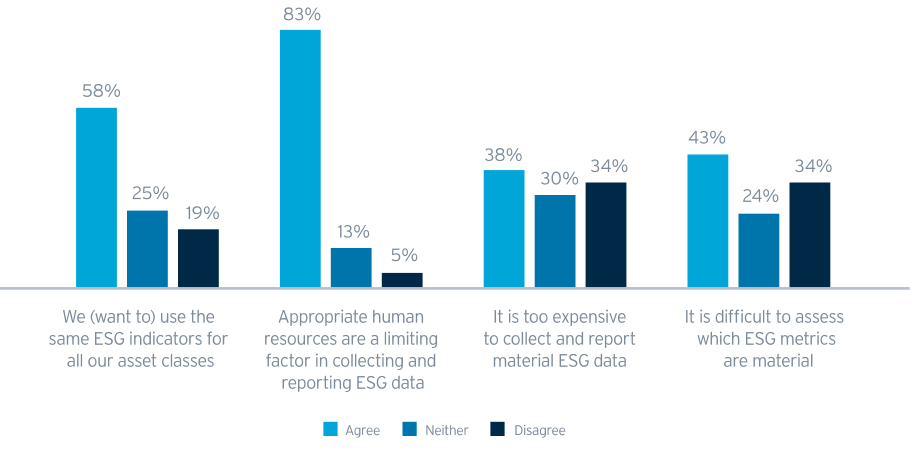
More generally, the survey highlighted three main issues in relation to ESG data collection and reporting:
- a lack of (human) resources for organisations currently getting to grips with ESG and what it means for them going forward;
- the lack of availability of data; and
- the poor quality of data collected.
Lack of resources
One nearly unanimous point of difficulty across survey respondents was the lack of appropriate human resources in collecting and reporting ESG data: 83% of respondents either agreed or strongly agreed that this was the case. Stephanie Mooij’s survey of asset owners and managers highlights this, too, estimating that the average HR or IR department (depending on the organisational structure) would need the work hours of approximately half another full-time employee to adequately respond to every survey and data collection exercise received, a problem that has only increased since that survey’s publication in 2017, when it had already been on the rise for years.
An organisation’s size can be similarly impactful on the difficulties it does or does not encounter when collecting ESG performance data. As Mooij observes, organisations with larger operations – who often happen to be part of industries requiring a strong reporting system in the first place (see below) – generally tend to encounter less trouble in reporting, since a larger overall organisational structure will generally require better reporting practices as well as a more developed human resources department. This might also prove to be advantageous when collecting data that falls in the social pillar of ESG. For many organisations it has been helpful to hire a sustainability/ESG expert either internally or as a consultant in an advisory role to bridge the gap and enable adequate ESG programme management.
Data availability
The survey revealed that members seem to face some difficulties in collecting the data they feel is relevant to them. A majority of survey responses suggested that, though members wanted to collect as much ESG data as possible, this was proving difficult in some areas.
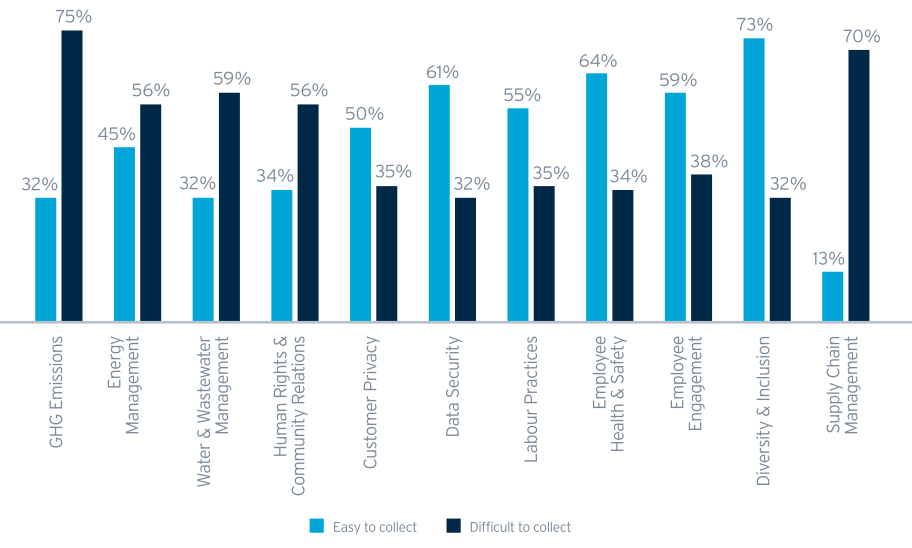
GHG Emissions and Supply Chain Management were considered the hardest to collect data on, followed by Water & Wastewater Management (highlighted by several members as a particularly difficult area given it was generally not relevant to many of their portfolio companies), Energy Management, and Human Rights & Community Relations.
Conversely, ESG areas such as Diversity & Inclusion, Employee Health & Safety, and Data Security were identified as the easiest to collect data on.
Despite these general conclusions, it is important to bear in mind that:
- The difficulty in collecting ESG data is often more company-specific than topic-specific, and thus will vary on a case-by-case basis depending on inter alia the business of the company, where it operates, its size/stage and historic issues. In response to the survey, one member raised a very astute point that they ‘[…] have some companies that can easily report on all topics and [some] companies that have a hard time answering all of [the required questions]’. One member response also described how, to alleviate pressure on their portfolio companies, they now only concentrate on a subset of KPIs relevant to that particular company, rather than asking for data that is not only difficult to find but also often not significantly relevant enough to warrant the extra effort.
- There are differences between industry- and company-specific factors. For example, an organisation involved in Oil & Gas, Mining, or any other extractive industry is much more likely to already have data that covers key metrics such as GHG Emissions or Water Management since this is pertinent to their operations beyond an ESG standpoint. However, for such industries, there is often less data readily available on non-financial issues such as Human Rights, Community Relations, or Biodiversity impact, since they have only become materially relevant in recent years. At the same time, certain industries are more able to collect the data they need because the nature of their operations and structure already requires a strong, robust reporting system that has at least some overlap with the metrics that need recording to assess their ESG performance.
Data quality
As ESG-related risks and metrics are continuing to be a priority for boards and other relevant stakeholders alike, the quality, consistency, and comparability of data remains of high importance. This is particularly relevant for an aggregate portfolio of multiple companies with diverse activities.
The challenge with the quality and consistency of data stems primarily from the fact that ESG as a concept is relatively new or at least newly important on the scale that it is in 2022. Additionally, the understanding of the ESG space is not yet fully matured. This novelty is reflected in the lack of standardization and transparency in the collection and scoring methodologies of data providers, for example. Many organisations themselves are still grappling with what ESG metrics are material to them internally and systemically within their industry. They are also coming to terms with what the frameworks/standards and regulations are requiring of them in terms of disclosure and reporting. All of this also means that there is no robust or extensive history of comparable data points for a lot of the ESG metrics as defined by the leading frameworks or standards. It is anticipated that challenges around data quality will persist (in particular in certain areas like GHG data) until there are more concrete regulatory requirements, for example in relation to verification.
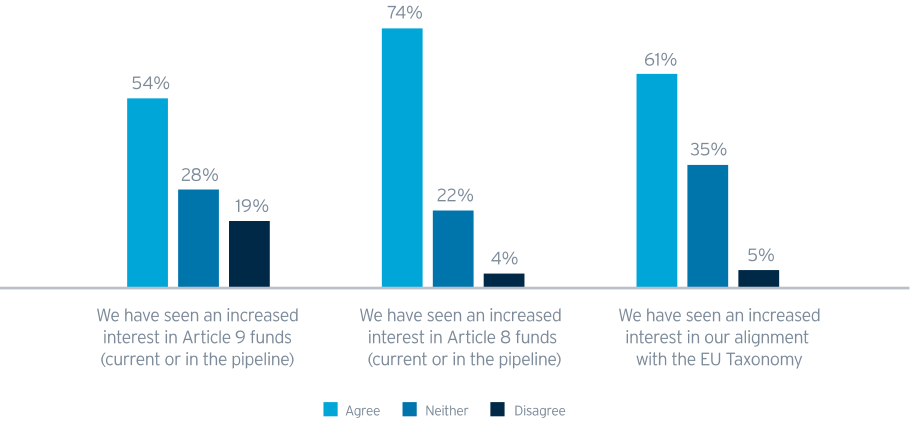
Data quality could be addressed in many cases by adhering to existing frameworks and standards which are illustrated in Figure 15 above. In addition, EU regulations like SFDR and the EU Taxonomy are likely to play an increasing role in improving the consistency of data over time. This expectation is supported by the Invest Europe member survey, which revealed that members are seeing an increasing interest in both SFDR Article 8 and Article 9 funds, and their alignment with the EU Taxonomy.
Explore all sections of the guide


Reporting template and tools
ESG reporting template ESG life cycle tool SFDR tools TCFD tools Timelines


Mapping of voluntary frameworks and standards
Definitions and distinctions Who is who Scope of information

Deep dive for VCs and investors
ESG reporting from a VC perspective ESG reporting from an investor perspective