Materiality assessment from a portfolio company perspective

As a general steer, a company’s materiality assessment should focus on identifying those factors that could have the most impact on the business from a risk or opportunity side. KPMG has developed a 7-phase sustainability materiality assessment framework, which could serve as a good starting point.
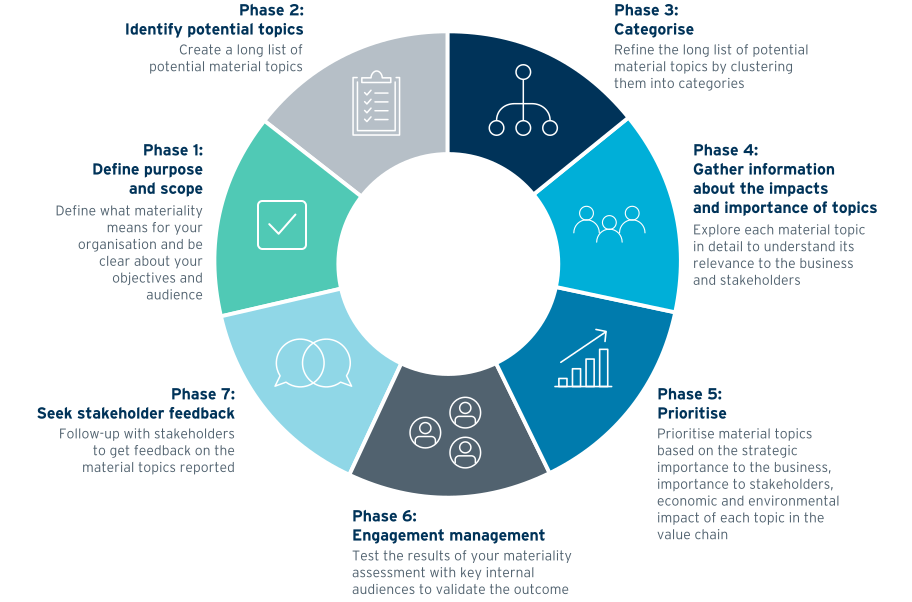
Figure 10: Sustainability materiality assessment framework
Source: Environmental, social and governance (ESG) materiality assessment (KPMG), August 2017
Using the above as an example, companies can start with defining what materiality means to them and clarifying the key audience and objectives of the exercise. Following this, companies can make a general list of potential material topics, before categorising the list, and exploring each material topic to understand its relevance both internally to the business, as well as to its stakeholders. After this initial research stage, companies can prioritise their material topics, test the results of their materiality assessment with key internal audiences and seek feedback from external stakeholders.
One good way to gauge what ESG factors are the most relevant for an organisation in a material sense is by talking to those with an operational focus. This could be executives and managers with a more general perspective, or those more closely involved in producing or providing the goods or services that an organisation offers. Getting their perspective on what ESG factors might have a significant impact on revenue growth, margins, capital, and risk can be very insightful. In practice, this will very often be done as part of Step 5 or 6, depending on the context.
Structuring these conversations around an existing framework for understanding ESG – examples include SASB and GRI, all of which focus on a wide range of data – is a helpful starting point to prompt discussion. Following what these frameworks would identify as significant ESG factors in an organisation or industry grouping can be a useful basis to get things going. For example, under the SASB framework, an organisation falling under Biotechnology & Pharmaceuticals would be asked about its supply chain management, business ethics, and customer welfare, among other things, which highlights these areas as potential topics to begin discussion. More specifically, the SASB Materiality Finder tool on the SASB website may be valuable in setting a direction to these conversations, since it gives access to industry-specific disclosure topics for each general category it addresses. For example, in Biotechnology & Pharmaceuticals, customer welfare is often assessed around the prevalence of counterfeit, substandard, or mislabelled drugs.
Stakeholder views
Alongside understanding an organisation’s own values and priorities, getting to grips with those of relevant stakeholders is crucial to successfully embrace ESG. Stakeholders are defined as those with an interest in the company, they have skin in the game, and so considering their opinions on what ESG factors are material and relevant to an organisation is important.
Key ESG stakeholders
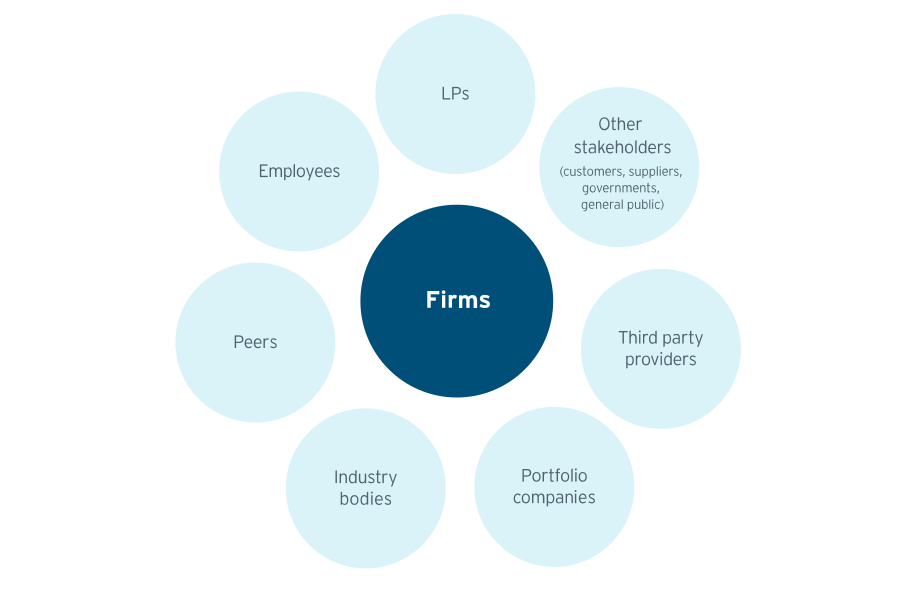
Figure 11: Key ESG stakeholders
Naturally, there is some overlap between stakeholders and those interviewed when understanding your organisation’s own priorities. One key stakeholder group in any organisation is its employees; other groups with an interest in the company might include investors, suppliers and vendors, customers, and even governments and communities. Hence, not only is there often a lot to collect, but it is also coming from a lot of different perspectives. For example, an investor, whose primary interest in an organisation will be financial value creation and return on their investment, might have very different priorities and concerns than employees or the wider community, who would often be more concerned about the social and environmental impact of an organisation.
Once all this data and information has been collected, reflecting on it in a way that illuminates what should be important to your organisation is another, sometimes difficult, task. This will encompass pulling all views together and reconciling potentially conflicting priorities and opinions into one cohesive, effective understanding of what ESG factors are relevant and material to your organisation. Using existing ESG frameworks as a guide can help to reach that understanding in a more structured way.
What can you do as a GP?
GPs should seek to partner with their portfolio companies to assist in these materiality assessments early, and thereby aim to enhance opportunities for sustainable growth and to reduce ESG risks.
For example, as part of the investment in a portfolio company, GPs could offer support in this process including:
- Sharing materiality frameworks relevant to their industry;
- Generating a potential stakeholder list for the company;
- Providing a template of survey questions for stakeholder engagements; and/or
- Identifying potential external vendors to help with a materiality assessment.
Some GPs will also go further and provide more detailed guidance to their portfolio companies, especially when they are just starting a materiality assessment and thinking about how to develop an ESG strategy.
A good starting point for such guidance could look as follows – though it can be tweaked according to the specific circumstances of your firm and its portfolio companies:
Step 1: Conduct an ESG Materiality Assessment
Step 2: Governance
Step 3: Strategy
Step 4: Risk Management
Step 5: Metrics & Targets
Step 6: Reporting & Disclosure
This is usually done by taking a long list of all potentially relevant ESG factors and deciding which ones are, or may soon become, financially material for your business. The list is usually narrowed down with input (usually via a survey) from executives, key employees, sometimes board members, and key customers. Existing frameworks, such as those set out by the Sustainability Accounting Standards Board (SASB) or the Global Reporting Initiative (GRI), are a good place to start.
SASB has identified the most financially material factors across 77 sectors. The information is free and online. It should be noted that SASB is entirely focused on financial materiality – it does not address broader topics under the general heading of ‘sustainability’ or ‘corporate social responsibility’ that might be of interest to your broader stakeholders like employees and customers.
Many of those issues are captured by the recommended indicators set out in the Global Reporting Initiative. Those indicators are not focused on financial materiality and tend to focus more on the impact the company is having on the world around it (whereas SASB is more focused on the impact changes in the world might have on the company). As a result, reporting that is aligned to GRI is much lengthier and more complex. While you don’t need to align your approach to GRI, there might be topics or indicators from GRI that you want to consider when you are creating a long list of potential ESG factors to consider.
As regards reporting frameworks, the recommendations of the Task Force on Climate-related Financial Disclosures, or TCFD, is the global standard for reporting on climate risks. TCFD-aligned reporting can be a longer-term goal. It is, however, important to consider any climate-specific risks as part of your ESG materiality assessment.
Once you decide which ESG factors are financially material, you will want to make sure that you have the right board level and management oversight of them, through your regular reporting mechanisms.
Here you should integrate financially material ESG factors into your corporate strategy, i.e., develop an approach that will help you avoid material ESG risks but also capitalize on ESG-related opportunities.
Any ESG-related risks that you identify should be integrated into your main enterprise risk management (ERM) systems and processes.
You should decide what ESG metrics you want to collect (SASB and GRI can help here) and then establish data collection systems and processes so that you are collecting the data in a reliable and consistent way.
You should develop an ESG/sustainability narrative and a communications strategy. You should decide what information you want to disclose and whether you want to align it to any of the frameworks mentioned above.
In this section of the guide



Explore all sections of the guide


Reporting template and tools
ESG reporting template ESG life cycle tool SFDR tools TCFD tools Timelines


Mapping of voluntary frameworks and standards
Definitions and distinctions Who is who Scope of information

Deep dive for VCs and investors
ESG reporting from a VC perspective ESG reporting from an investor perspective