Background

What is the SFDR?
The Sustainable Finance Disclosure Regulation (SFDR) imposes significant sustainability-related transparency and disclosure requirements on a wide range of EU-authorised firms and non-EU funds marketed in the EU and potentially non-EU managers of such funds.
In particular, it requires EU-regulated asset managers and financial advisers and certain non-EU asset managers to take into account sustainability risks in their investment decision-making, and to explain to investors or clients in a consistent manner how they do so. The SFDR sets the standards for financial products, as well as portfolio management and investment advisory mandates, that incorporate environmental, social and governance considerations in their investment approach. Investors are increasingly seeking investment products that are classified as “sustainable” according to the SFDR’s standards.
In a separate Regulation, firms within scope of the Markets in Financial Instruments Directive (MiFID) providing financial advice and portfolio management will need to carry out a mandatory assessment of sustainability preferences of clients, take into account sustainability risks when complying with the MiFID organisational requirements and integrate sustainability risk into risk management policies, as well as consider sustainability factors in the product approval process and product governance arrangements1. Likewise, firms within scope of the Alternative Investment Fund Managers Directive (AIFMD) must consider sustainability risks in due diligence policies and internal conflicts of interest and risk management policies2.
The Corporate Sustainability Reporting Directive (CSRD) considerably expands the sustainability reporting required by certain EU and non-EU companies (including large private companies) that are in-scope of the requirements. Reporting will be required in accordance with the new European Sustainability Reporting Standards (ESRS). The reporting standards that are being produced under the CSRD include all the “principal adverse impact” indicators under the SFDR.
What is the Taxonomy Regulation?
The separate Taxonomy Regulation governs the EU’s initiative for an EU-wide classification system of economic activities – such as generation of energy from renewable sources or low carbon emitting manufacturing – that the EU defines as environmentally sustainable.
The Regulation sets six environmental objectives:
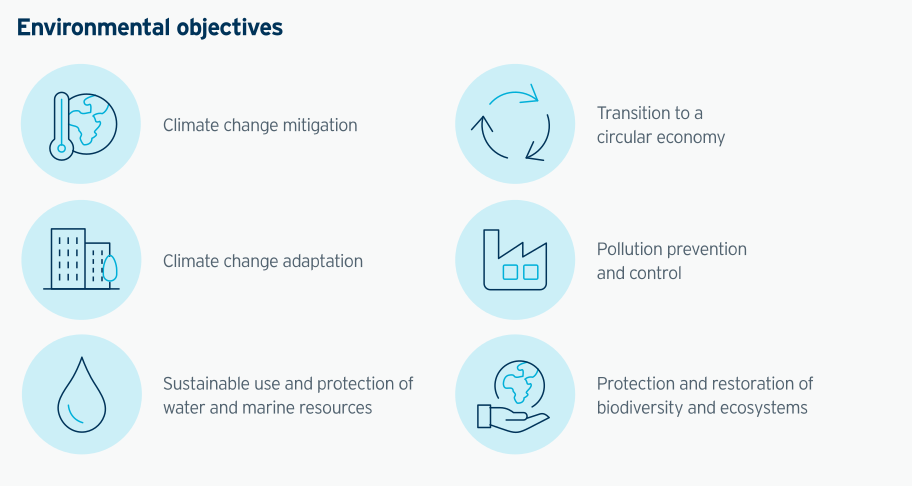
The Taxonomy also introduces disclosure requirements for financial services firms in relation to the environmentally sustainable activities carried on by their investments, and disclosure requirements for companies in scope in relation to their own economic activities. The Taxonomy Regulation’s technical screening criteria were the outcome of considerable work, both at a technical and political level, to determine a set of economic activities that contribute to an environmental objective, drawing on existing EU methodologies, labelling and certification schemes. Reflecting the EU’s plan to achieve carbon neutrality by 2050, the Taxonomy Regulation (and associated technical screening criteria) initially focussed on climate change issues, with the Taxonomy Regulation applying on 1 January 2022 in respect of the two climate change objectives. The Platform on Sustainable Finance published its advice to the Commission on technical screening criteria for the four other environmental objectives in March and November 2022 and May 2023, which the Commission is due to adopt in the form of Regulatory Technical Standards (RTS) to take effect from 1 January 2024.
Taxonomy-eligible economic activities are activities covered by the Taxonomy Regulation (see section on Economic activities covered by the Taxonomy Regulation) whilst Taxonomy-aligned economic activities are activities that are both covered by the Taxonomy Regulation and meet its technical screening criteria (see section on Calculating proportion of investments aligned with the Taxonomy).
Companies in scope of the Non-Financial Reporting Directive (large “public interest entities” with more than 500 employees, which mainly comprises EU listed companies, credit institutions and insurance undertakings) must report on the proportion of their activities which are Taxonomy eligible and, in due course, Taxonomy-aligned activities. The CSRD expands and replaces the NFRD and imposes certain reporting obligations under the EU Taxonomy Regulation to companies in scope of CSRD.
Taxonomy – What is next?
- It is expected that the Taxonomy Regulation will play a very important role in asset allocation decisions in EU capital markets in the future. EU policy makers will use it as the basis for directing capital flows towards environmentally sustainable activities, including, in the fund management sphere, to encourage investment in financial products that meet EU-wide standards to invest in environmentally sustainable projects and companies. EU authorities are also expected to use it as a means to determine the environmentally linked risk of a particular asset.
- It is anticipated that the Taxonomy will cover more economic activities over time. For example, the Complementary Climate Delegated Regulation introduced technical screening criteria for certain nuclear energy and fossil gas-related economic activities to be considered environmentally sustainable from 1 January 2023. As a result, Article 8 and Article 9 products are required to report on the degree to which they carry out, fund or have exposures to Taxonomy-aligned nuclear energy and fossil gas-related activities.
- Furthermore, on 29 March 2022, the EU Platform on Sustainable Finance published its Final Report on Taxonomy extension options supporting a sustainable transition. If adopted, the proposal would bring wholesale changes to the current Taxonomy Regulation moving away from, what is in principle, a binary system (Taxonomy-aligned and other) to a multi-categorisation system.
- The Taxonomy Regulation flags the possibility of establishing a brown taxonomy (a taxonomy of environmentally harmful activities), a taxonomy of “low impact” environmentally sustainable activities and a social taxonomy, but does not commit itself to this project. To that end, the EU’s Platform on Sustainable Finance published its Final Report on Social Taxonomy in February 2022, outlining its scope and material for the contribution (including a set of specific social objectives) and do no significant harm tests, but the progress of this project is unknown.
1. Delegated Regulation (EU) 2017/565 and Delegated Directive (EU) 2017/593, supplementing MiFID.
2. Commission Delegated Regulation (EU) 2021/1255, amending Delegated Regulation (EU) 231/2013










Explore all sections of the guide


Reporting template and tools
ESG reporting template ESG life cycle tool SFDR tools TCFD tools Timelines


Mapping of voluntary frameworks and standards
Definitions and distinctions Who is who Scope of information

Deep dive for VCs and investors
ESG reporting from a VC perspective ESG reporting from an investor perspective