Product-level disclosures

The FCA has recognised that public product level disclosures will not be appropriate in all circumstances and so there are two sub-types of product level disclosures: public TCFD product reports and on-demand TCFD product reports.
Public TCFD product report
On-demand TCFD product reports and underlying asset data
Public TCFD product report
On-demand TCFD product reports and underlying asset data
Scope
Where?
What?
Timings
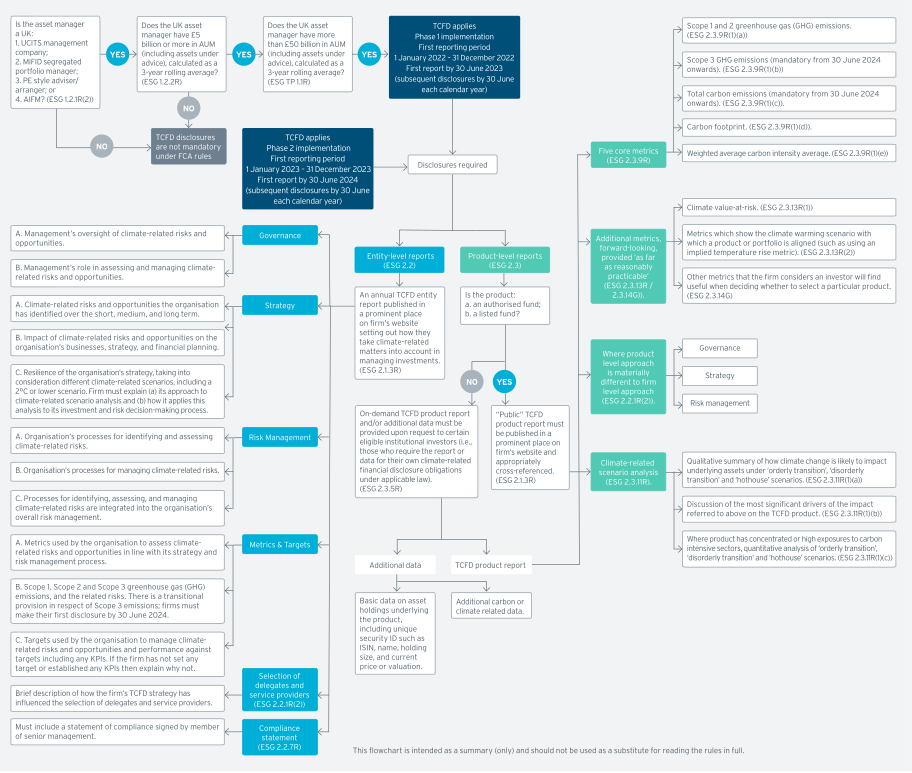
The requirement to prepare and publish a public TCFD product-level report principally1 applies in respect of listed funds (listed on a recognised exchange) and authorised funds (UCITS, NURS, QIS and LTAF) and so it is likely that most private equity and venture capital fund managers and advisers will not need to publish a public TCFD product-level report.
Reports should be issued at fund or, where relevant, sub-fund level. There is no need to issue a report in respect of a fund/sub-fund which is in the process of winding up2.
1. The full definition is contained at Glossary Terms - FCA Handbook
2. ESG 2.3.4R
AIFMs managing an unauthorised listed AIF should annex the TCFD product report to the Firm's entity-level report or include a hyperlink to the TCFD product report in the entity-level report1.
Other Firms should publish any product-level reports in a prominent place on the Firm's main business website and,
- in the case of an authorised fund, include the report or a hyperlink to it in a) the fund's annual report, and b) where the publication of the half-yearly report more closely follows the 30 June reporting deadline, the fund's half-yearly report;
- where the Firm is managing investments, include the report or a hyperlink to it in the periodic report or statement of securities which most closely follows the 30 June reporting deadline2.
1. ESG 2.3.2R
2. ESG 2.3.1R
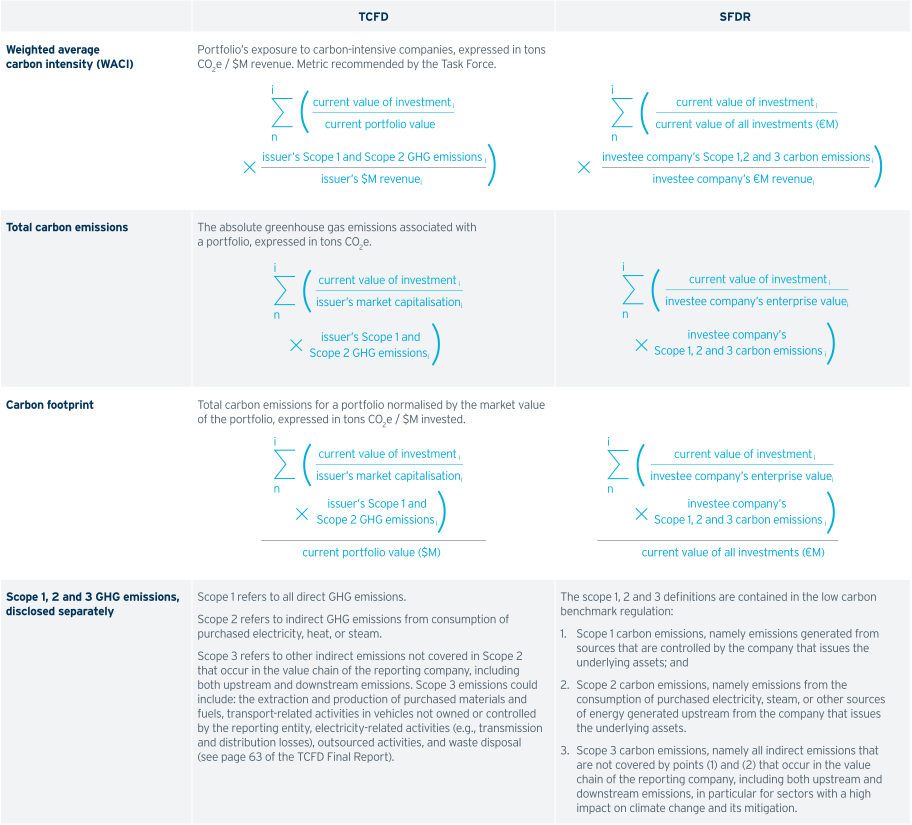
The FCA has recognised the difficulties in reporting scope 3 emissions and so the first reporting deadline in respect of scope 3 emissions is 30 June 20242.
These metrics should be calculated in accordance with the methodologies set out in the TCFD annex having regard to the TCFD Guidance on Metrics, Targets and Transition Plans and should be accompanied by:
- historical annual calculations from any previous TCFD product reports3. Currently there is no limit on the age of such historical data that should be included although the FCA has said it will consider such a limit as part of its post-implementation review; and
- an explanation of how they should be interpreted and any associated limitations including a description of where assumptions and proxies have been used4.
The FCA has mentioned that it may seek to use these metrics as a partial basis for a new product labelling regime (UK SDR). These metrics overlap with certain principal adverse sustainability indicators specified under EU SFDR although the calculation methodologies for metrics scope 3 emissions, total carbon emissions and WACI are different.
Deviations from TCFD entity-level report
Where the approach in relation to the product materially deviates from the overarching Firm approach disclosed in the TCFD entity-level report, this should be disclosed with appropriate cross-referencing between the two reports5.
Two forward-looking metrics
So far as reasonably practicable the report should include two forward-looking metrics6:
1 - Climate value-at-risk (VaR)
VaR is an estimate of the effect that one or more warming scenarios will, at a particular probability, have on the value of the portfolio as compared to a scenario where no further warming occurs.
2 - Metric(s) which show the climate warming scenario with which a product or portfolio is aligned, e.g., an implied temperature rise metric
An implied temperature rise (ITR) metric attempts to estimate a global temperature rise associated with the greenhouse gas emissions from the entities in the portfolio or fund or within the scope of the investment strategy. Expressed as a numeric degree rating, ITR incorporates current GHG emissions or other data and assumptions to estimate expected future emissions associated with the selected entities. Then, the estimate is translated into a projected increase in global average temperature (in °C) above pre-industrial levels that would occur if all companies in corresponding sectors had the same carbon intensity as the selected asset(s).
These metrics are less established, and their calculation methodologies are still evolving. When looking to make these disclosures Firms may find the Task Force's Forward-Looking Financial Sector Metrics consultation a useful starting point.
Additional metrics
Additional metrics may be included in the report where the firm considers that an investor would find them useful in selecting a TCFD product. However, calculation methodologies must be clearly explained and the metrics presented in a way that is not more prominent than that of the five core metrics7. The FCA has suggested that when considering additional metrics Firms may wish to refer to the list of recommended metrics in the CFRF disclosure guide.
Scenario analysis8
The report must include a qualitative summary of how climate change is likely to impact underlying assets under ‘orderly transition’, ‘disorderly transition’ and ‘hothouse’ scenarios. For products which have "concentrated or high exposures" to carbon intensive sectors, quantitative analysis under these three scenarios must also be included. The FCA has refrained from defining concentrated or high exposures for fear of inadvertently creating a product category which would be viewed negatively by investors9. Firms should also disclose the most significant drivers of impact upon the product; these might include, for example, market and technology shifts, reputation, changes in policy and law or the physical impact of climate change.
1. ESG 2.3.9R(1)
2. EST TP1 1.6
3. ESG 2.3.9R(b)
4. ESG 2.3.9R(a)
5. ESG 2.3.9R(2)(c) and 2.3.10
6. ESG 2.3.13R
7. ESG 2.3.14G
8. ESG 2.3.11R
9. CP 21/17 5.49
The publication deadline for the first product report will depend on the Firm's AUM. Reports must be published by 30 June each calendar year1. A calculation date within the reporting period must be adopted and this should reflect the most up-to-date information the Firm has available.
1. ESG 2.1.1R(1)
Scope
What?
Timings
Most private equity and venture capital fund managers and advisers that are in scope of the FCA's TCFD rules will have to comply with the requirement to prepare “on-demand” product reports (instead of publishing a public report for the product) and, where appropriate, respond to investor requests for additional information. Specifically, the obligation to provide reports and/or information is with respect to:
- clients in receipt of portfolio management services (see extended definition); and
- investors in an unauthorised AIF managed by a UK AIFM which is not listed on a recognised investment exchange,
where the client or investor requires the relevant information in order to satisfy climate-related financial disclosure obligations as a result of a legal or regulatory requirement1. Although not strictly required, Firms are encouraged to make available to investors/clients disclosures broadly equivalent to an on-demand TCFD product report irrespective of whether the client/investor needs such information to satisfy legal or regulatory obligations2.
AIFMD-exempt AIFs (those which are closed-ended and make no additional investments after 22 July 2013) are exempt from TCFD product reporting requirements including in respect of underlying asset data. There are no other exemptions for legacy products contained in the rules.
1. ESG 2.3.5R
2. ESG 2.3.7G
An eligible investor or client may, once per entity level reporting period, request an on-demand TCFD product report and/or additional data1.
The content requirements for an on-demand TCFD product report are the same as for a public TCFD product report.
Additional data may consist of:
- basic data on asset holdings underlying a TCFD product, including unique security ID such as ISIN, name, holding size, and current price or valuation, as reasonably required by the relevant person to produce their own amalgamated scenario analysis and otherwise satisfy their own disclosure obligations in relation to climate-related financial information2; and/or
- additional climate or carbon-related data. A Firm is only required to provide additional climate or carbon-related data if:
- the data is reasonably required in order to satisfy climate-related financial disclosure obligations;
- it is reasonably practicable for the Firm to provide the data; and
- providing the data does not place the Firm in breach of contractual obligations governing the Firm’s use of the data3.
1. ESG 2.3.6R
2. Glossary
3. ESG 2.3.8R
Upon receipt of a request for an on-demand TCFD product report and/or additional data the Firm must prepare and provide the information within a reasonable time period (and in a format which the Firm considers appropriate to the needs of the requesting investor/client)1.
A calculation date within the reporting period must be adopted and this should reflect the most up-to-date information the Firm has available or, alternatively, the calculation date may be as agreed between the client/investor and the Firm2. [In practice, it seems likely that Firms will wish to adopt a single calculation date across the board.]
Investor/client on demand requests may be made no earlier than 1 July 2023 to Phase 1 Firms and no earlier than 1 July 2024 to Phase 2 Firms. Investors/clients may only make requests in respect of reporting periods during which the client/investor's arrangements with the Firm concerning the TCFD product were in place3.
1. ESG 2.1.1R(2)
2. ESG 2.3.5R
3. ESG 2.3.5R
In this section of the guide





Explore all sections of the guide


Reporting template and tools
ESG reporting template ESG life cycle tool SFDR tools TCFD tools Timelines


Mapping of voluntary frameworks and standards
Definitions and distinctions Who is who Scope of information

Deep dive for VCs and investors
ESG reporting from a VC perspective ESG reporting from an investor perspective