Alignment with other EU Sustainable Finance initiatives

Links between CSRD, SFDR and Taxonomy
The CSRD is one of the core pillars of the EU’s sustainable finance framework, alongside the SFDR and the EU Taxonomy. The purpose of the CSRD is for companies to report on their sustainability risks and impacts, as well as their percentage alignment (current and future revenues) from Taxonomy-aligned activities. This information is then passed on to both financial market participants and advisers, as well as to other end users. Financial market participants will then in turn use reported data under the CSRD to satisfy their own reporting obligations under the SFDR.
The reporting standards in the CSRD will correspond in part to the indicators contained in the SFDR. Article 8 of the EU Taxonomy Regulation also requires companies falling within the scope of the NFRD and the CSRD to report on the sustainability of their activities. The final reporting standards of the CSRD will take into account the ‘substantial contribution’ and ‘do-no-significant-harm’ criteria of the Taxonomy Regulation. Please see the section on SFDR and the EU Taxonomy for more information on these criteria.
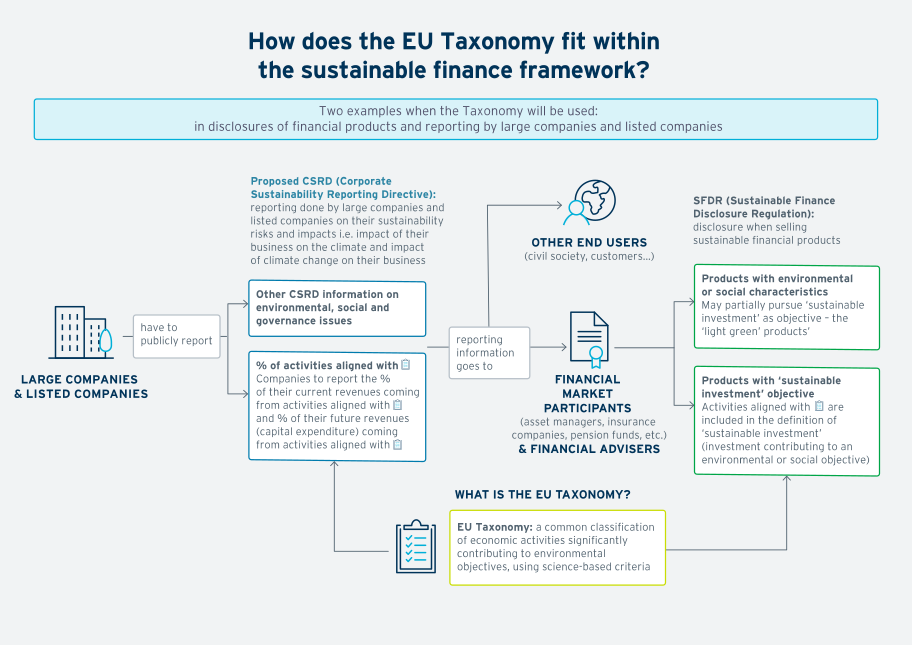
Figure 29: Links between CSRD, SFDR and Taxonomy
Source: European Commission factsheet
CSRD and the proposal for a Directive on corporate sustainability due diligence
On 23 February 2022, the European Commission published a proposal for a Directive on corporate sustainability due diligence (CS3D), which aims to foster responsible and sustainable corporate practices through the whole value chain. The new due diligence rules would apply to large EU companies (i.e., 500+ employees and EUR 150 million+ in net turnover worldwide), and other companies from high-impact sectors with more than 250 employees and a EUR 40 million+ net turnover worldwide. They would also apply to non-EU companies active in the EU, with the same turnover threshold when generated in the EU (for the lower threshold, 50% of worldwide turnover should be in a high-risk sector). These companies would have to implement due diligence into policies, identify human rights and environmental impacts, mitigate, and minimise these impacts, publicly communicate on due diligence, etc.
The easiest way to think about the link between the CS3D and CSRD is that the CS3D outlines how companies should identify and take action to improve the ESG credibility of their value chains, while the CSRD implements processes to collect and report data on ESG. Thus, the CS3D should lead to more complete and effective reporting under the CSRD. The CSRD and CS3D will give rise to the following synergies:
- Proper collection of information for publication under the proposed CSRD requires companies to implement processes, which is closely linked to the identification of negative impacts under the new sustainability due diligence established by the CS3D.
- The CSRD will cover the final stage of sustainability due diligence, i.e., the publication requirement, for companies that are also covered by both regimes.
- The CS3D will impose an obligation on companies to implement a plan to ensure that the business model and strategy are compatible with the transition to a sustainable economy and with limiting global warming to 1.5°C, in line with the Paris Agreement on which the CSRD is to report.
Clarifications from the European institutions are expected in order to allow firms to better understand and coordinate their regulatory obligations arising from the CSRD, the proposed CS3D, the EU Taxonomy Regulation, and the SFDR as these instruments are intrinsically linked, albeit not wholly aligned at this stage.
In this section of the guide




Explore all sections of the guide


Reporting template and tools
ESG reporting template ESG life cycle tool SFDR tools TCFD tools Timelines


Mapping of voluntary frameworks and standards
Definitions and distinctions Who is who Scope of information

Deep dive for VCs and investors
ESG reporting from a VC perspective ESG reporting from an investor perspective