Taxonomy Regulation

Environmentally sustainable investments
The Taxonomy Regulation sets out the following circumstances under which economic activities can qualify as environmentally sustainable or “Taxonomy-aligned”. In order for the activity to be Taxonomy-aligned it must:

Economic activities under the Taxonomy
Minimum social safeguards
Calculating Taxonomy alignment
Economic activities under the Taxonomy
Minimum social safeguards
Calculating Taxonomy alignment

Economic activities covered by the Taxonomy Regulation
The number of economic activities covered by the Taxonomy Regulation (and which can qualify as Taxonomy-aligned) is relatively small but will expand over time. At present, TSC only exist for the first two environmental objectives, relating to approximately 140 economic activities. On 30 March 2022, the EU Platform on Sustainable Finance published a report setting out recommendations to the Commission on the TSC for economic activities for the four remaining environmental objectives. The report also proposed TSC for some of these economic activities in relation to the first two environmental objectives. Although it was due prior to 1 January 2023, the Commission has not yet brought forward a related legislative proposal for technical screening criteria applying to the remaining four environmental objectives. The EU Platform on Sustainable Finance has to date prioritised drafting TSC for those economic activities that it considers contribute most to the Taxonomy’s environmental objectives. The Commission published a draft notice on the interpretation and implementation of certain legal provisions of the technical screening criteria in December 2022.
In defining economic activities, the Taxonomy has adopted the European NACE code system. Not all European companies use the NACE code system but the Technical Expert Group has mapped NACE codes to other commonly used sector codes. A list of economic activities currently covered by the Taxonomy and their technical screening criteria is set out in the Taxonomy Compass.
Transitional and enabling activities
The Taxonomy Regulation currently recognises two subcategories of Taxonomy-aligned economic activities: transitional activities and enabling activities.
| Transitional activities | Enabling activities |
|
|
Due diligence in relation to minimum social safeguards
A firm will also need to conduct due diligence to avoid any breach of the minimum social safeguards specified in the Taxonomy Regulation. The minimum social safeguards are procedures implemented by the investee company to ensure its alignment with:
| Guideline | What is included |
| The OECD Guidelines for Multinational Enterprises |
|
| The UN Guiding Principles on Business and Human Rights, including the principles and rights set out in the eight fundamental conventions identified in the Declaration of the International Labour Organisation on Fundamental Principles and Rights at Work and the International Bill of Human Rights |
|
The European Commission’s Platform on Sustainable Finance published in 2022 its Final Report on Minimum Safeguards under the EU Taxonomy Regulation (the “Report on Minimum Safeguards”). This sets out the checks for firms to determine, as required by the Taxonomy Regulation, whether investee companies have in place “minimum safeguards” in relation to human rights, as well as other business practices.
Under the headings of human rights, corruption, taxation and fair competition, the Report on Minimum Safeguards recommends criteria for checking compliance with the minimum safeguards, with different scales of checks required, depending on whether the company is in scope of the CSRD or a small to medium-sized enterprise (“SME”). The checks proposed are essentially:
- Whether the company has established adequate human rights due diligence processes, anti-corruption processes, tax risk management processes and promotion of employee awareness of the importance of competition law compliance. Investors may find some external data available for these checks but will largely need to do their own assessments. The Report on Minimum Safeguards proposes checking human rights processes and measures by reference to the Reporting Standards being developed under the CSRD.
- Whether there is evidence that the company did not adequately implement human rights due diligence through the company or senior management finally found to be in breach of labour law or human rights, or through processes initiated by OECD “National Contact Points” or the Business and Human Rights Resource Centre. If a company has been found to have committed a human rights breach, it will need to show that it has provided remedies and made definite improvements in its processes. Smaller companies are not considered compliant if the company has not established human rights due diligence proportionate to its size and risks, or if the company has been found in breach of human rights, labour rights or consumer rights.
Whilst the Report is focused on the standard required to check Minimum Safeguards under the Taxonomy Regulation, it also impacts firms that wish to qualify their investments as “sustainable investments” under the SFDR but outside the Taxonomy Regulation. The sustainable investment test under the SFDR requires a firm to ensure that investments do not significantly harm any social objective. The social factors of the PAI indicators form the basis of this test. The Taxonomy Regulation also requires firms, when checking for Minimum Safeguards, to adhere to the principle of DNSH under the SFDR. The PAI social factors include “Violations of UN Global Compact Principles and OECD Guidelines” and “Lack of processes and compliance mechanisms to monitor compliance with UN Global Compact Principles and OECD Guidelines”. Thus, the material that the Report on Minimum Safeguards proposes for checking compliance with the UN Global Compact Principles and the OECD Guidelines is a standard that firms could use under the DNSH test. Similarly, the Article 8 and Article 9 pre-contractual disclosure templates include the question “How are the sustainable investments aligned with the OECD Guidelines and UN Guiding Principles”, and the Report on Minimum Safeguards provides a basis for answering this question.
A private equity sponsor should consider which elements of the investment are high risk in terms of human rights due diligence. High-risk elements include investments in jurisdictions where human rights are not protected in domestic law, where there is active conflict, where corruption is prevalent or where the business activity may impact vulnerable groups. Holding periods, the size of the investment and the nature of the markets in which they invest are also factors in the level of due diligence expected by private equity sponsors.
Calculating proportion of investments aligned with the Taxonomy
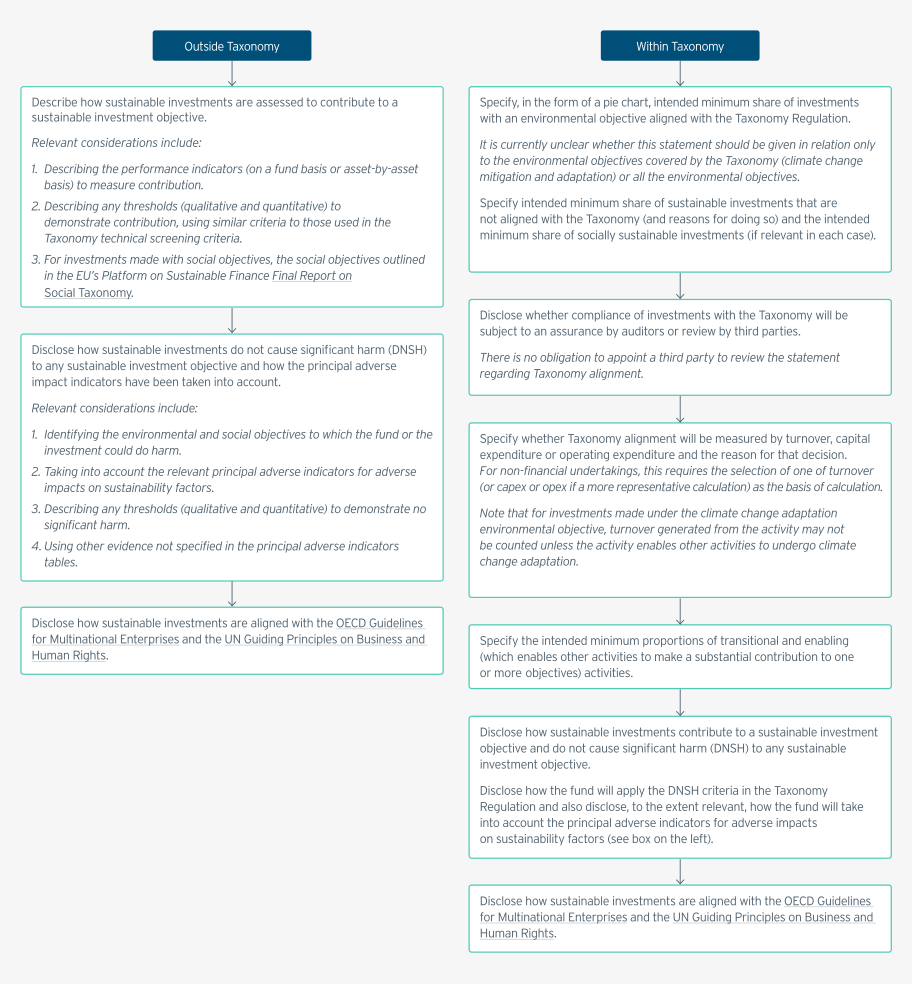
All Article 8 and Article 9 funds must report periodically on the proportion of their underlying investments that are in Taxonomy-aligned activities.
Funds can only disclose information on Taxonomy alignment where they have reliable data – but it is not a prerequisite that the underlying investment itself is under an obligation to report Taxonomy-aligned information for the fund to report on Taxonomy alignment of that investment.
In relation to the steps a fund should take to assess Taxonomy alignment of the portfolio, the Commission confirmed in the Q&A that funds can only disclose information on Taxonomy alignment where they have reliable data – but it is not a prerequisite that the underlying investment itself is under an obligation to report Taxonomy-aligned information for the fund to report on Taxonomy alignment of that investment. The Commission also stated that estimates of Taxonomy alignment (on the basis of information from other sources, such as proxies) “should only compensate for limited and specific parts of the desired data elements, and produce a prudent outcome.”
Even if for larger asset managers subject to the NFRD, it is permitted to use estimates for assessing Taxonomy alignment of third country portfolio investments, no similar rule is included in the SFDR. It therefore is questionable if and to what extent estimates could be used. In fact, according to a statement in March 2022 issued by the ESAs, estimates should not be used to assess Taxonomy alignment, even if information is not publicly available (but in such case, it is possible to rely on equivalent information provided by the portfolio companies).
Firms will need to calculate and report Taxonomy alignment by reference to three financial indicators:
- Turnover
- Capital expenditure (Capex)
- Operating expenditure (Opex)
These indicators will produce different Taxonomy alignment scores where the fund has invested in one or more companies that perform a mixture of Taxonomy-aligned and other economic activities.
For example, an investee company performs two economic activities, where activity A is Taxonomy-aligned and activity B is not. Activity A represents a high proportion of turnover and opex but a low proportion of capex. As a result, the company produces a high Taxonomy- alignment percentage under the turnover and opex measures but a low percentage under the capex measure. In its clarifications on the ESAs’ draft RTS under the SFDR of June 2022, the ESAs confirmed that “the pre-contractual disclosure is designed to favour the measurement of a non-financial investee undertaking’s Taxonomy contribution by turnover”, and that funds could use capex or opex if that is a more representative calculation.
In relation to Taxonomy-alignment reporting by funds-of-funds, the ESAs state that “the calculation of the Taxonomy alignment of a financial product investing in another financial product (including funds-of-funds) should be based on the market value of the proportion of Taxonomy-aligned investments of the latter.”
The reported Taxonomy alignment of the fund should be calculated (by all three financial indicators) according to the following formula:
In calculating the numerator, different types of investments are treated differently. For example, for debt securities and equities of an investee company, where a proportion of activities of the investee company are Taxonomy-aligned, only the market value of that proportion of those debt securities or equities should be included in the numerator. For bonds issued under the European Green Bond Standard, the full value of those securities should be included, as the proceeds must be used to finance Taxonomy-compliant projects or economic activities.
Is a firm required to use an external service provider for Taxonomy assessment?
There is no explicit requirement for external assurance or audit for the Taxonomy assessment. This is unlike the position for companies within scope of the extension of the Non-Financial Reporting Directive, the Corporate Sustainability Reporting Directive (CSRD), which envisages companies that report, inter alia, on the Taxonomy alignment of their activities to obtain a degree of external assurance of the information, from existing auditors or newly authorised independent assurance service providers.
In practice, where private equity sponsors cannot rely on an investee company performing its own Taxonomy-related audit of its activities, the investor will need technical assistance to apply the technical screening criteria and may well rely on a form of external assurance in this regard. The Commission has flagged the absence of any requirement for investors to seek external verification or assurance of their disclosures as an area for future review. In the meantime, sponsors will be mindful of their existing obligations for the accuracy and presentation of pre-contractual and periodic reporting when assessing Taxonomy alignment.
The Taxonomy Regulation requires non-financial undertakings under the scope of the Non-Financial Reporting Directive to disclose the proportion of their turnover (amounts derived from sale of products and provision of services), capital expenditures and operating expenditure associated with environmentally sustainable economic activities, consistent with the EU Taxonomy. At present, most private equity-backed companies will not be within the scope of this obligation and so, that data will not be readily available. The CSRD will extend the scope of this obligation to a wider array of companies. The CSRD is covered in more detail here.










Explore all sections of the guide


Reporting template and tools
ESG reporting template ESG life cycle tool SFDR tools TCFD tools Timelines


Mapping of voluntary frameworks and standards
Definitions and distinctions Who is who Scope of information

Deep dive for VCs and investors
ESG reporting from a VC perspective ESG reporting from an investor perspective