Guide menu

Invest Europe ESG Reporting Guidelines

International Sustainability Standards Board (ISSB)

B2 Who Is Who

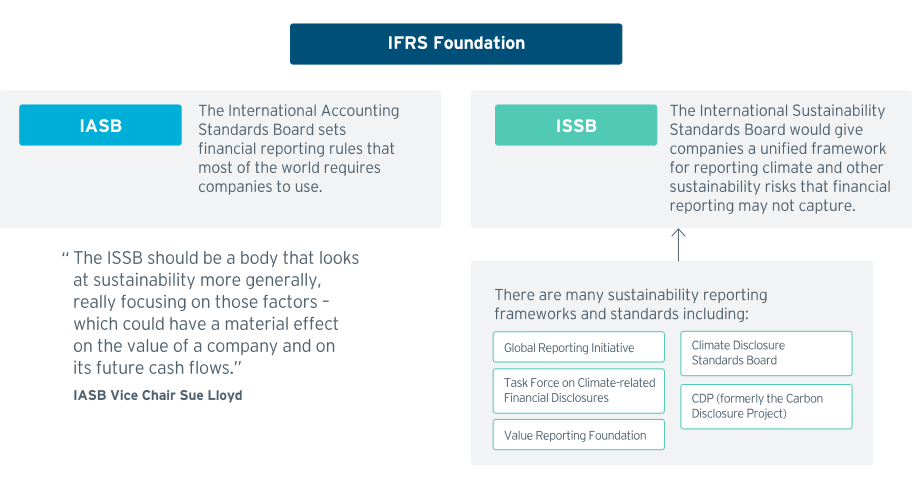
The landscape of ESG reporting standards has been changing a lot lately, and further movements are expected in the coming months. Well-known standard setting bodies like the Sustainability Accounting Standards Board (SASB), the Climate Disclosure Standards Board (CDSB) and the Global Reporting Initiative (GRI) will over time all merge into the International Sustainability Standards Board (ISSB).

Announced by the IFRS Foundation during the COP26 forum in Glasgow in November 2021, the ISSB intends to meet the demand for “high quality, transparent, reliable, and comparable” disclosures of ESG performance. The primary intent of the IFRS Foundation’s ISSB project is to harmonize ESG standards by creating a thorough global baseline for ESG reporting that is “focused on the needs of investors and financial markets”.

The Board also aims to retain connectivity between the International Accounting Standards Board (IASB) and the ISSB to embed sustainability into core capital market infrastructure on the same level of importance as financial accounting standards.

Concretely, the ISSB will combine multiple frameworks, building on the work of existing investor-focused reporting initiatives, including the CDSB, the TCFD, the Value Reporting Foundation’s Integrated Reporting Framework and SASB Standards, and the World Economic Forum’s Stakeholder Capitalism Metrics, to become the global standard-setter for sustainability disclosures for the financial markets.

The Value Reporting Foundation’s SASB Standards serve as a key starting point for the development of the IFRS Sustainability Disclosure Standards, while the Integrated Reporting Framework provides connectivity between financial statements and sustainability-related financial disclosures. The IFRS advises that companies should continue using the existing voluntary frameworks and guidance as appropriate in the period before the ISSB’s standards are issued.

Key milestones in the establishment of the ISSB

Logo Value Reporting Foundation

In November 2020 the International Integrated Reporting Council (IIRC) and the Sustainability Accounting Standards Board (SASB) announced their intention to merge into the Value Reporting Foundation, which was officially formed in June 2021.

As such, the Value Reporting Foundation became a global non-profit organisation that offers a comprehensive suite of resources designed to help businesses and investors develop a shared understanding of enterprise value – how it is created, preserved, and eroded. Their resources include:

  • The Integrated Thinking Principles, which guide board and management planning and decision making.
  • The <IR> Framework, which provides principles-based, multi-capital guidance for comprehensive corporate reporting reflecting the commercial, social and environmental context in which an organisation operates. An integrated report under the <IR> Framework extends to six capitals combining traditional dimensions such as Financial capital, Manufactured capital, Intellectual capital and Human capital with Social and relationship capital and Natural capital. An integrated report includes eight Content Elements that are fundamentally linked to each other and are not mutually exclusive:
    • Organisational overview and external environment
    • Governance
    • Business model
    • Risks and opportunities
    • Strategy and resource allocation
    • Performance
    • Outlook
    • Basis of presentation
  • The SASB Standards, which are a tool to inform disclosure to investors and guide investor decision-making when embedded in investment tools and processes. SASB’s sustainability topics, identified from an initial set of 30 broadly relevant sustainability issues, are organised under five broad sustainability dimensions including (1) environment, (2) social capital, (3) human capital, (4) business model and innovation, and (5) leadership and governance. The SASB Standards encompass a complete set of 77 globally applicable industry standards, including detailed industry-specific disclosure topics and metrics, and addressing sustainability-related risks and opportunities reasonably likely to affect an organisation’s financial condition (i.e., its balance sheet), operating performance (i.e., its income statement), or risk profile (i.e., its market valuation and cost of capital).

On 31 January 2022, the CDSB was consolidated into the IFRS Foundation to support the work of the ISSB.

Recognising the need to further harmonise the sustainability reporting landscape at an international level, in March 2022 the IFRS Foundation and the Global Reporting Initiative (GRI) announced that they would collaborate and join each other’s consultative bodies to coordinate the setting of sustainability standards. By working together, the IFRS Foundation and the GRI provide two interconnected ‘pillars’ of international sustainability reporting:

  • a first pillar representing investor-focused capital market standards (IFRS Sustainability Disclosure Standards developed by the ISSB), and

  • a second pillar of GRI sustainability reporting requirements set by the Global Sustainability Standards Board (GSSB), compatible with the first, designed to meet multi-stakeholder needs.

Prior to the announcement by the GRI and ISSB, a statement of cooperation on international sustainability reporting convergence was agreed between the GRI and the European Financial Reporting Advisory Group (EFRAG).

On 1 August 2022, the IFRS Foundation announced the completion of the consolidation of the Value Reporting Foundation into the IFRS Foundation.

Visit website

Explore all sections of the guide