EU portfolio companies

The aim of this section of the guide is to present a general overview of the Corporate Sustainability Reporting Directive (CSRD) within the EU sustainability regulatory framework, and the main impacts the legislation will have on companies (in particular, companies who are already subject to the NFRD) based on the recently agreed CSRD proposal.
There might be country-specific reporting requirements for companies in specific sectors or with respect to certain ESG issues, such as modern slavery or child labour, but they are not covered in this chapter.
Background
The Non-Financial Reporting Directive (Directive 2014/95/EU, ‘NFRD’) adopted in 2014 brought in requirements for certain large undertakings to disclose non-financial information, and to publish this information (covering human rights, environmental and social matters, anti-corruption, and diversity) in their annual report.
Building on this, and largely down to the increased emphasis on ESG under the current European Commission leadership, it was decided in 2019 to revise the NFRD to address the existing shortcomings (in terms of comparability, readability, and effectiveness of disclosures) and to improve the quality of the data being reported to investors, aiming to ensure that their societal impact was clear.
Published on 21 April 2021, the Commission’s proposal for a Corporate Sustainability Reporting Directive (CSRD) amends a number of other legislations such as: the ‘Accounting Directive’ (on annual and consolidated financial statements); the Transparency Directive (on the harmonisation of transparency requirements); the ‘Audit Directive’ (on statutory audits of annual accounts); and, the ‘Audit Regulation’ (on the specific requirements for the statutory audit of Public-Interest Entities (PIEs)).
The main novelties of the CSRD, which significantly amends the NFRD, are:
To introduce new sustainability disclosure requirements and to clarify the information and the way companies should report in line with EU sustainability reporting standards;
To extend the scope of the reporting requirements to all companies listed on a regulated market (except listed micro-companies) and all large companies, regardless of the legal status; and,
To amend Directive 2006/43/EC (the Audit Directive) and Regulation No 537/2014/EU (the Audit Regulation) by requiring assurance for sustainability information.
In a nutshell:
| NFRD | CSRD |
Target audience | Under the NFRD, any ‘large public-interest companies’ with more than 500 employees were targeted, which covered approximately 11,700 large companies and groups including listed companies, banks and insurance companies. | The CSRD extends the scope of the NFRD to all large companies and all listed companies, except for listed micro-enterprises – as such moving from approximately 12,000 firms under the NFRD to around 50,000 firms under the CSRD. |
Scope of disclosure | The NFRD required companies to publish information annually in relation to:
| The CSRD greatly extends the amount of information to be disclosed and introduces detailed reporting requirements, including reporting according to mandatory EU sustainability reporting standards being developed. |
New requirements |
| A general EU-wide audit requirement is being introduced to improve the accuracy of reporting and to increase the reliability of the sustainability information presented by companies to investors. Companies will also be expected to digitally tag the information, meaning that the information will be machine readable and will feed into the European Single Access Point (ESAP). |
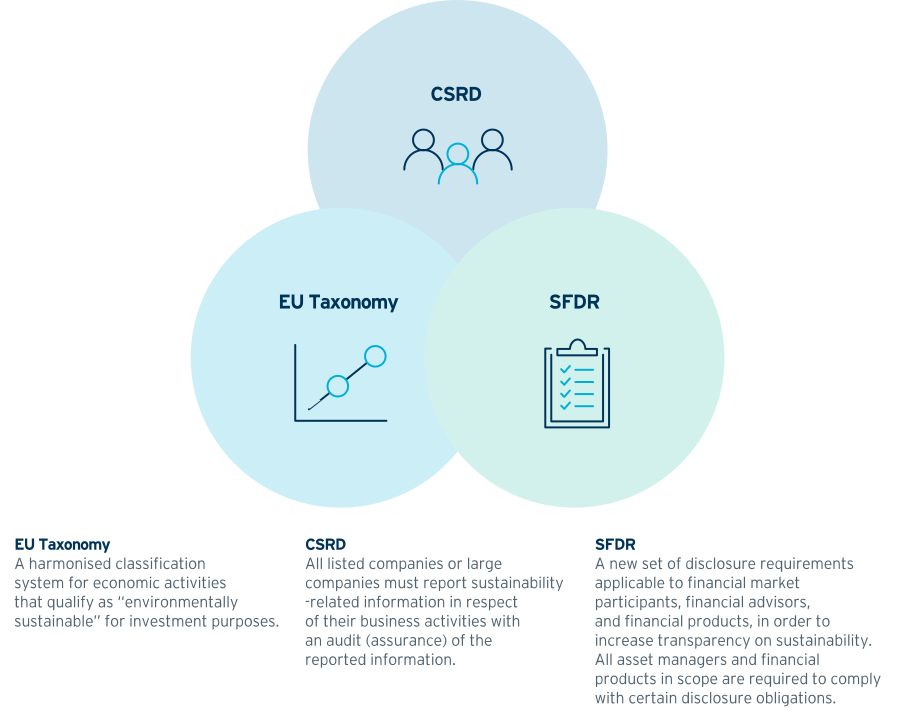
By amending the NFRD, the Commission is responding to investor demand for more ESG information (e.g., on the environmental impact of their investee companies). This also links in with the requirements under the SFDR and the EU Taxonomy Regulation. By enlarging the scope of companies subject to ESG reporting and imposing new requirements, the CSRD will allow investors to have richer data with which to report.
On 21 June 2022, following interinstitutional negotiations, the European Parliament and the Council reached a provisional political agreement on the CSRD draft text. This provisional agreement is subject to approval by the Council and the European Parliament.
Member States will have 18 months to transpose the legislation from its entry into force, with the deadline for compliance by entities currently subject to the NFRD set on 1 January 2024.
Common ESG reporting standards
To ensure comparability and clarity in implementation, the European Commission’s technical advisor, the European Financial Reporting Advisory Group (EFRAG), is currently developing common, mandatory sustainability reporting standards. The European Commission has until 31 October 2022 to adopt those common reporting standards, though this timeline could shift further towards the end of the year.
The standards will be tailored to existing EU policies on financial reporting, such as the principal adverse impacts (“PAIs”) under the Sustainable Finance Disclosure Regulation (“SFDR”). At present, disclosure requirements under development by EFRAG look to be extensive, with two cross-cutting standards, five environmental standards, four social standards and two governance standards.
Separate, proportionate standards are to be developed for in-scope SMEs by 31 October 2023, adapted to the resources of such companies. SMEs listed on regulated markets will be required to apply these proportionate standards, while unlisted SMEs will be able to choose to apply them on a voluntary basis.




Explore all sections of the guide


Reporting template and tools
ESG reporting template ESG life cycle tool SFDR tools TCFD tools Timelines


Mapping of voluntary frameworks and standards
Definitions and distinctions Who is who Scope of information

Deep dive for VCs and investors
ESG reporting from a VC perspective ESG reporting from an investor perspective