Entity-level reporting

What?
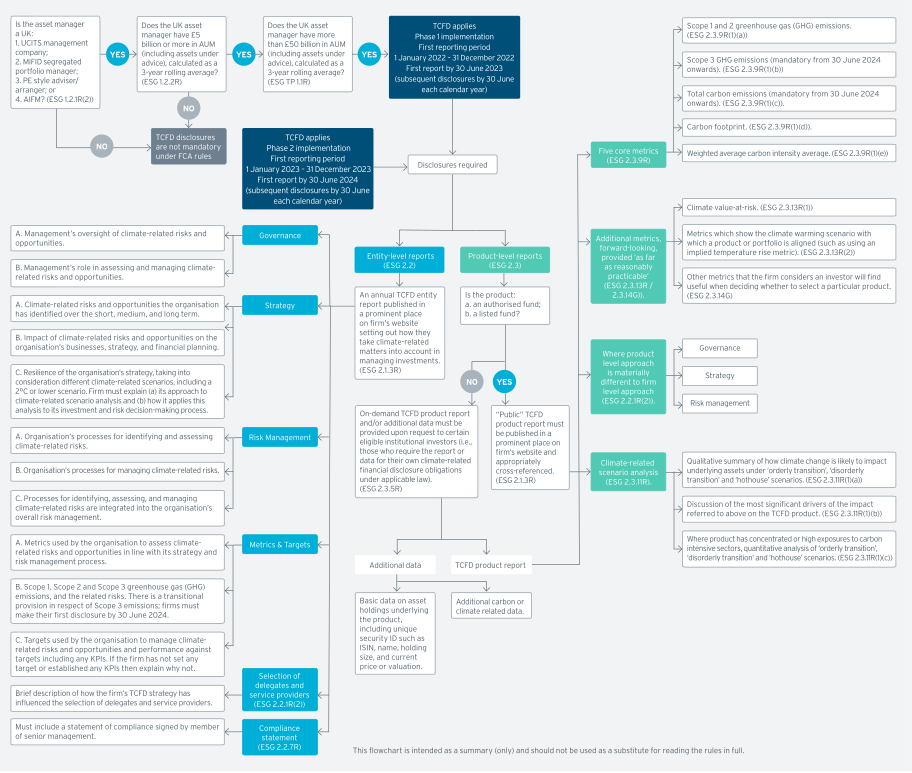
Disclosures should be made under each of the TCFD’s core themes regarding a Firm’s TCFD in-scope business1. In summary, the following should be included in the entity-level report:
Governance
Strategy
Risk management
Metrics and targets
Disclose the organisation's governance around climate-related risks and opportunities:
describe the board's oversight of climate-related risks and opportunities; and
describe the management's role in assessing and managing climate-related risks and opportunities[1].
1. Ibid 19
Disclose the actual and potential impacts of climate-related risks and opportunities on the organisation's business, strategy, and financial planning where such information is material:
describe the climate-related risks and opportunities the organisation has identified over the short, medium, and long term;
describe the impact of climate-related risks and opportunities on the organisation's business, strategy, and financial planning; and
describe the resilience of the organisation's strategy, taking into consideration different climate-related scenarios, including a 2°C or lower scenario1.
FCA gold-plating
This section should include:
an explanation of the Firm's approach to climate-related scenario analysis;
an explanation of how the Firm applies climate-related scenario analysis in its investment and risk decision-making process; and
where reasonably practicable, quantitative examples to demonstrate its approach to climate-related scenario analysis2.
Firms must also explain how this strategy has influenced its delegation and outsourcing arrangements3.
1. Task Force for Climate-related Financial Disclosures, "TCFD Annex: Implementing the Recommendations of the Task Force on Climate-related Financial Disclosures" (October 2021), 18
2. ESG 2.2.3R
3. ESG 2.2.1R(3)
Disclose how the organisation identifies, assesses, and manages climate-related risks:
describe their processes for identifying and assessing climate-related risks;
describe their processes for managing climate-related risks; and
describe how processes for identifying, assessing, and managing climate-related risks are integrated into the organisation's overall risk management1.
1. Task Force for Climate-related Financial Disclosure (n 3), 21
Disclose the metrics and targets used to assess and manage relevant climate-related risks and opportunities where such information is material:
disclosing the metrics used by the organisation to assess climate-related risks and opportunities in line with its strategy and risk management process;
disclosing Scope 1, Scope 2, and Scope 3 greenhouse gas emissions, and the related risks; and
describing the targets used by the organisation to manage climate-related risks and opportunities and performance targets1.
There is a transitional provision in respect of Scope 3 emissions data which benefits Phase 1 Firms; Firms have until 30 June 2024 to report Scope 3 data for the first time.
FCA gold-plating
On a comply or explain basis, a firm must describe the targets it has set to manage climate-related risks and opportunities, including the KPIs it uses to measure progress against these targets2.
1. Task Force for Climate-related Financial Disclosures (n 5), 21
2. ESG 2.2.4R
Compliance statement
The entity report must include a statement signed by a member of a Firm’s senior management that the report (including any group or third-party report cross-referred to) complies with the FCA rules. This individual does not need to be a director or partner of the Firm2.
Where?
The report must be published in a prominent place on the Firm’s main business website3. Note that the Firm's entity-level report will be public, even if the Firm is not required to produce any public TCFD product level reports.
Timings
- Reports must be published by 30 June of each calendar year reflecting a reporting period starting no earlier than 1 January of the previous calendar year4.
- Reporting periods must run consecutively and may not exceed 12 months in length5.
- Reporting periods should generally be 12 months in length but where a firm wishes to change the dates of its reporting period it may issue an interim report to avoid exceeding the 12-month limit6.
- A calculation date within the reporting period must be adopted and this should reflect the most up-to-date information that the Firm has available7.
The deadline for publishing the first entity-level report is dependent on the Firm’s AUM (see above).
- For Firms above the £50bn AUM threshold there must be no period of time after 1 January 2022 which is not covered by a TCFD entity report8.
- For Firms below the £50bn threshold there must be no period of time after 1 January 2023 that is not covered by a TCFD entity report9.
Use of cross-referencing
If a Firm is a member of a group, it may also rely on climate-related financial disclosures made by another member of the group, but only to the extent that the disclosures are relevant to the Firm and cover the assets the Firm administers or manages. In such circumstances the Firm must:
- include cross-references and hyperlinks in its own TCFD report to the relevant part(s) in the group report which relate to the assets managed or administered by the Firm;
- clearly set out the rationale for relying on the group disclosures; and
- explain any discrepancies between the group report and the approach taken by the Firm to its TCFD reports10.
A group report referred to need not be issued by a UK entity.
There are separate provisions governing situations where a Firm wishes to refer to climate-related disclosures made by itself or a member of its group in accordance with the UK listing rules11.
1. ESG 2.2.1R(1)
2. ESG 2.2.7R
3. ESG 2.1.3R
4. ESG 2.1.1R(1) and ESG 2.1.2R(2)
5. ESG 2.1.2R(1) and (2)
6. ESG 2.1.2R(2)
7. ESG 2.1.2R(3) and 2.1.8R
8. ESG 2.1.2R(2)
9. ESG TP1 1.4
10. ESG 2.2.5R
11. ESG 2.2.6R
In this section of the guide





Explore all sections of the guide


Reporting template and tools
ESG reporting template ESG life cycle tool SFDR tools TCFD tools Timelines


Mapping of voluntary frameworks and standards
Definitions and distinctions Who is who Scope of information

Deep dive for VCs and investors
ESG reporting from a VC perspective ESG reporting from an investor perspective