UK TCFD

What is the TCFD?
The Task Force on Climate-related Financial Disclosures (the “Task Force”) was established by the Financial Stability Board in 2015 to identify the information required by investors, lenders and insurance underwriters to accurately assess and price climate-related risks and opportunities1. In particular, the Task Force was asked to develop a consistent suite of climate-related disclosures which would be useful across the investment ecosystem. The Task Force structured its recommendations around four core themes (which are relevant to all businesses):
Core elements of recommended climate-related financial disclosures
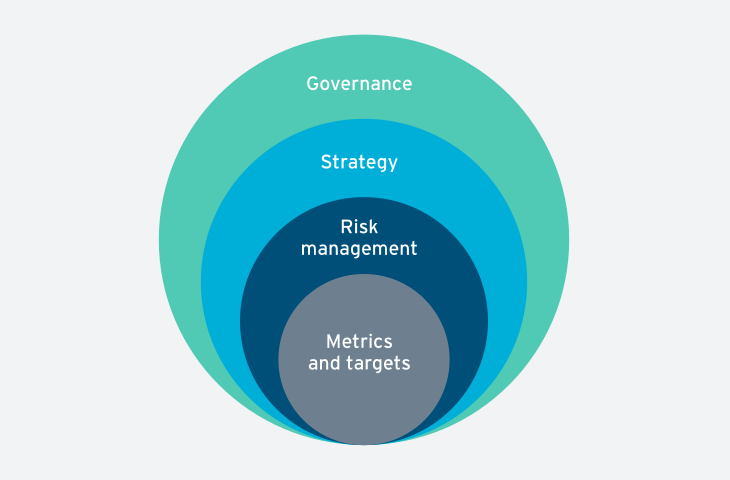
Figure 30: Core elements of recommended climate-related financial disclosures (Source: TCFD / PRI)
Governance
The organisation’s governance around climate-related risks and opportunitiesStrategy
The actual and potential impacts of climate-related risks and opportunities on the organisation’s businesses, strategy, and financial planningRisk management
The processes used by the organisation to identify, assess, and manage climate-related risksMetrics and targets
The metrics and targets used to assess and manage relevant climate-related risks and opportunities
Under these core themes sit eleven recommended disclosures. The disclosures seek to provide decision-useful, climate-related financial information. The Task Force’s recommendations were voluntary and have no legal force in their own right.
TCFD for UK Asset Managers
The UK government has been supportive of the TCFD recommendations and, in November 2020, published its "Roadmap towards mandatory climate-related disclosures". The Roadmap set out a path towards mandatory TCFD-aligned climate-related disclosures across most of the UK economy by 2025. Building on this Roadmap, the UK’s Financial Conduct Authority (FCA) introduced new rules (included in a new “ESG Sourcebook”) on 1 January 2022 following a consultations process2. The new FCA rules mandate TCFD-aligned reporting for certain UK asset managers and asset owners, including many UK-regulated private equity and venture capital firms and some of their investors. The ESG Sourcebook provides for the following types of reporting by in-scope entities:
| Level of reporting | Nature of reporting |
| Entity level reporting - i.e., at the level of the UK regulated firm | Public |
| Product level reporting - i.e., at the level of the fund or portfolio |
Either:
|
(In this section, we shall refer to these collectively as the “TCFD reports”.)
In due course, TCFD reporting by UK asset managers (and others, including corporates) will be supplemented by the Sustainability Disclosure Requirements (SDR), a separate UK sustainability-related disclosure and product labelling regime. The SDR regime is in development and is not (yet) dealt with in this chapter.
There is also a separate obligation for large UK-incorporated private companies3 and LLPs4 to produce TCFD-aligned climate disclosures in their annual report. Companies with more than 500 employees and a turnover of more than £500m are in scope and the reporting obligations began on 6 April 2022 with disclosures covering the reporting periods starting on or after this date. Although UK portfolio companies may be affected, most private equity firms will not meet the size thresholds and will not, therefore, be captured by these obligations (which are therefore not dealt with in this chapter).
1. Task Force on Climate-related Financial Disclosures, "Recommendations of the Task Force on Climate-related Financial Disclosures" (June 2017)
2. See CP 21/17, PS 21/24
3. See the Companies (Strategic Report) (Climate-related Financial Disclosure) Regulations 2022
4. See the Limited Liability Partnerships (Climate-related Financial Disclosure) Regulations 2022





Explore all sections of the guide


Reporting template and tools
ESG reporting template ESG life cycle tool SFDR tools TCFD tools Timelines


Mapping of voluntary frameworks and standards
Definitions and distinctions Who is who Scope of information

Deep dive for VCs and investors
ESG reporting from a VC perspective ESG reporting from an investor perspective