Fund-related disclosures

How to classify an AIF under SFDR
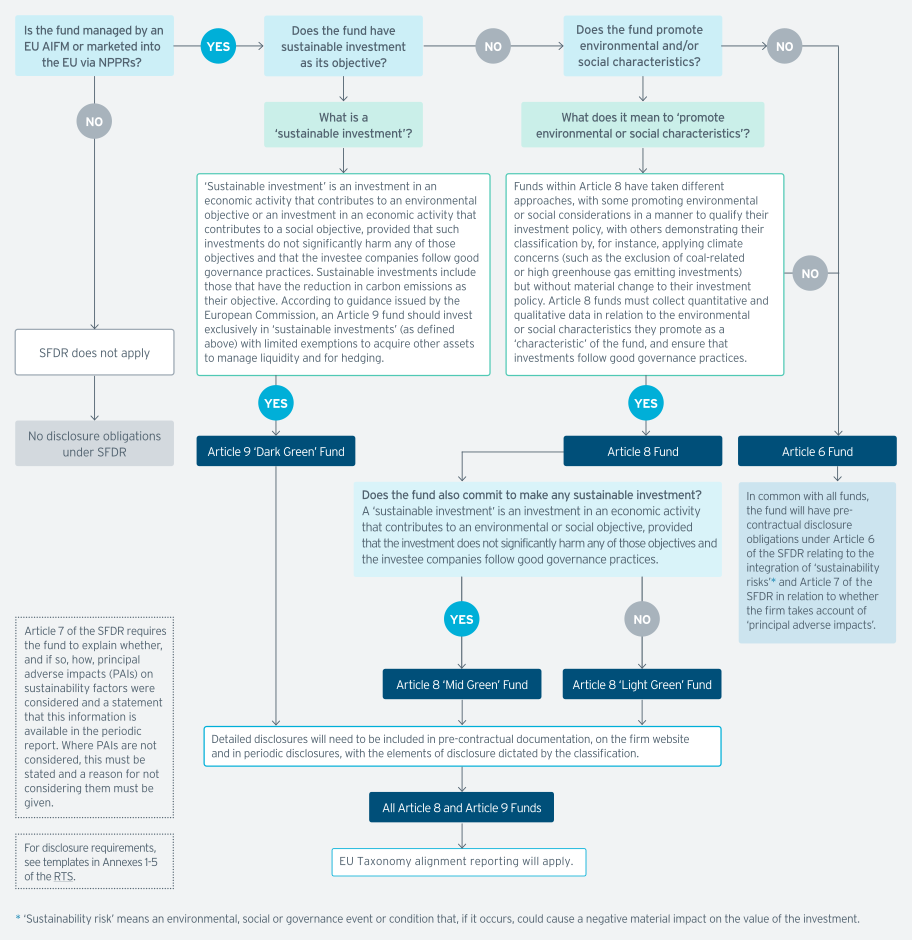
For an overview of classifying a fund under the SFDR, see the chart below. This chart, and in particular the disclosure obligations described, deals with SFDR product-level obligations and does not deal with firm-level obligations that are additionally required for in-scope firms.
Sustainability risk policy
Principal adverse impacts
Promotion of environmental or social characteristics
Funds with sustainable investment as their objective
Sustainability risk policy
Principal adverse impacts
Promotion of environmental or social characteristics
Funds with sustainable investment as their objective
Sustainability risk policy1
Firms must include information on the integration of “sustainability risks” in their investment decision-making process in pre-contractual disclosures for funds and other mandates and the result of an assessment of the likely impacts of sustainability risks on the returns of the product. If the firm decides that sustainability risks are not relevant to the fund in question (which might be the case in respect of a feeder fund, for example), the firm will need to provide a clear and concise statement why sustainability risks are not integrated into their investment decisions.
Similarly, financial advisers must include a description in pre-contractual disclosures of the manner in which sustainability risks are integrated into investment advice and the result of an assessment of the likely impacts of sustainability risks on the returns of the financial products advised on. In the Commission’s responses to the ESAs’ question published in May 2022, the Commission confirmed that the obligation to provide information about sustainability risks in investment advice applies to advice given on all financial instruments, and not only advice on financial products that are themselves in scope of SFDR.
This disclosure obligation is supplemented by the related changes to MiFID for financial advisers to carry out an assessment of sustainability preferences of clients for products that invest a minimum proportion in Taxonomy-aligned environmentally sustainable investments or other sustainable investments, or products that consider principal adverse impacts on sustainability factors, and to prepare client reports that explain how the recommendation meets a client’s investment objectives, risk profile, capacity for loss bearing and sustainability preferences. These changes will apply to firms that distribute funds under a MiFID authorisation or appoint a third-party distributor. Third-party distributors are likely to request sustainability-related information on the product and may do this with the European ESG Template (EET) prepared by FinDatEx. Firms may be familiar with the European MiFID Template (EMT), which is designed to facilitate similar, non-sustainability-related information exchanges.
Principal adverse impacts2
The European Commission’s May 2022 Q&A and the ESAs’ clarifications of June 2022 confirm that, separately to the Article 4/7 regime, PAIs can be a promoted characteristic for an Article 8 fund or form part of the sustainable investment objective for an Article 9 fund. Moreover, the Q&A allows firms that do not consider firm-level PAIs under Article 4 to comply for certain products that they manage with PAI disclosure under Article 7 and to exclude such products from the scope of their Article 4 opt-out website statement.
| Where a firm considers principal adverse impacts for a particular fund or mandate (under Article 7): | Where the firm does not consider principal adverse impacts at firm level (under Article 4): |
|
|
The ESAs’ clarifications of June 2022 confirm that, for a fund-of-funds, where the investee company is a collective investment undertaking, information about the adverse impacts of the investment decisions “could look through to the individual underlying investments”, and, where such information is not available, the information could also contain details of best efforts used to obtain such information from the investee companies or through other sources, or through reasonable assumptions.
Promotion of environmental or social characteristics3
Where a financial product promotes, among other characteristics, “environmental or social characteristics, or a combination of those characteristics, provided that the companies in which the investments are made follow good governance practices”, the firm must disclose the following information in the product's pre-contractual disclosure:
- Information on how those characteristics are met; and
- If an index has been designated as a reference benchmark, information on whether and how this index is consistent with those characteristics.
Funds in scope of this provision of the SFDR are referred to as Article 8 funds.
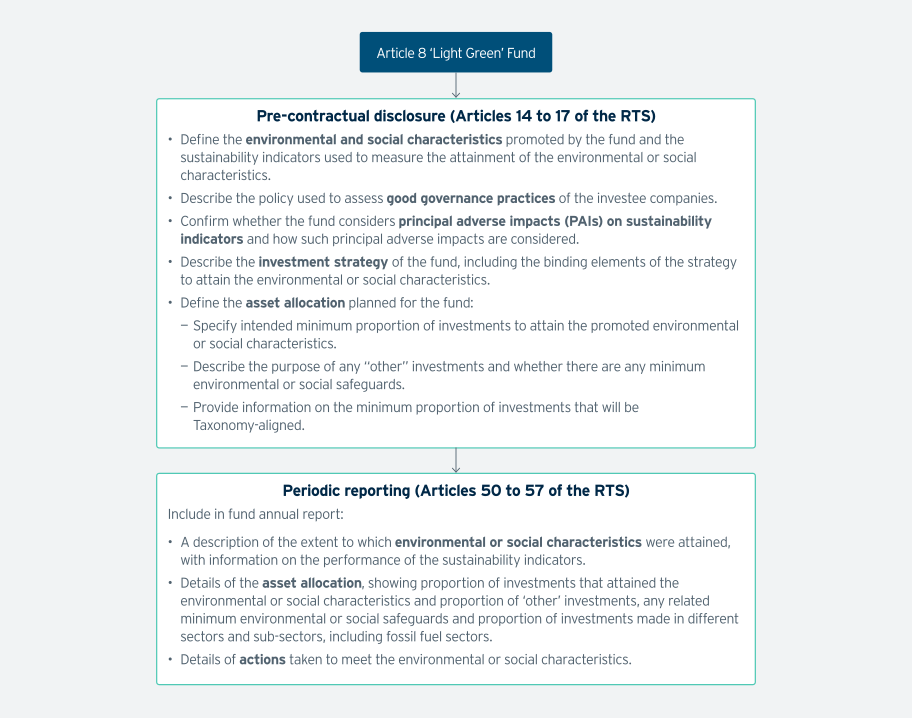
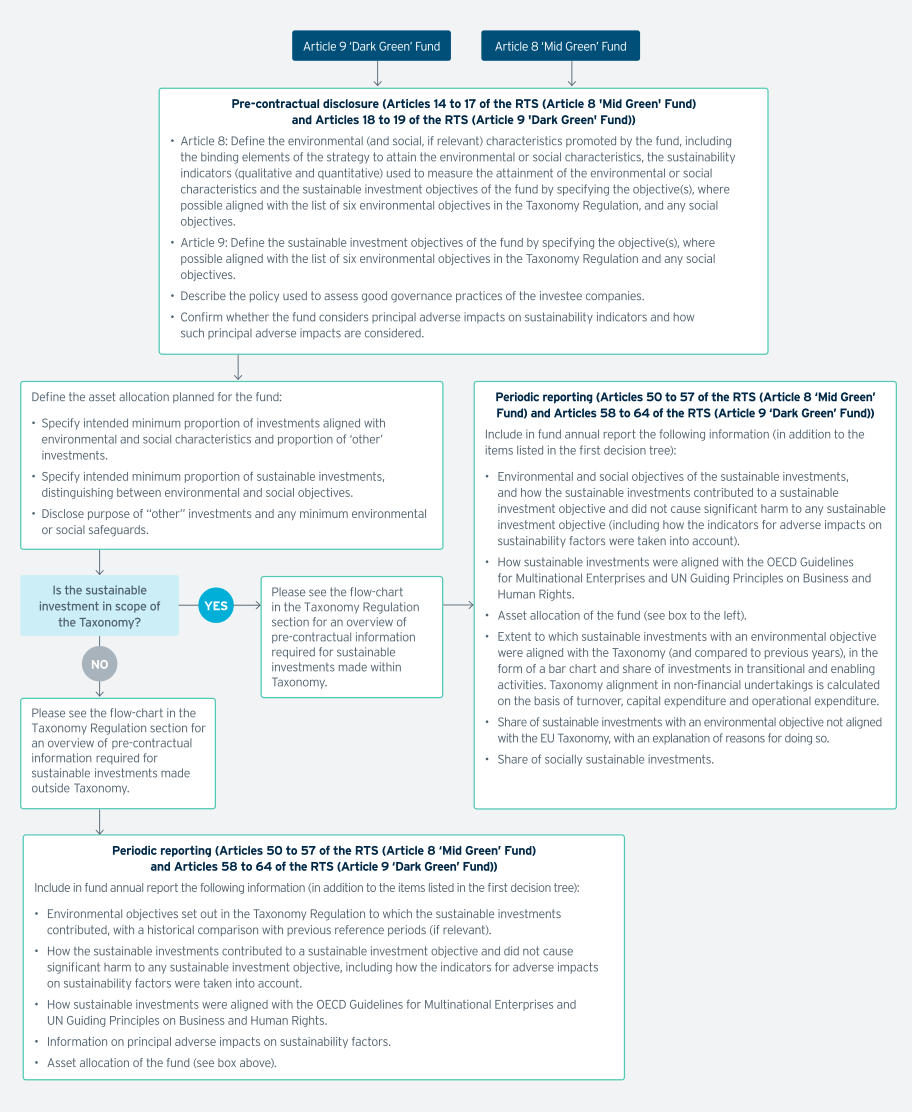
For an overview of the pre-contractual disclosure and periodic reporting obligations for a fund classified under Article 8 of the SFDR, see the charts “Summary of pre-contractual information required for Article 8 “Light Green” Fund” and “Summary of pre-contractual information required for Article 9 ‘Dark Green’ and Article 8 ‘Mid Green’ Fund” below.
What information is a firm required to disclose on the promotion of environmental and social characteristics?
Does Article 8 limit a firm’s investment strategy?
What is the obligation in relation to “good governance”?
Does a fund need to make sustainable investments in order to qualify under Article 8?
What is a sustainable investment?
What does the “do no significant harm” test entail?
Does the DNSH test apply on an ongoing basis?
Does the Taxonomy Regulation apply to Article 8 funds?
Is a Taxonomy-aligned investment also a sustainable investment under the SFDR?
The key requirement under Article 8 is for a fund to disclose information on the environmental and social characteristics promoted. This involves completion of the template pre-contractual disclosure and ongoing investor reporting in the Level 2 Regulatory Technical Standards. According to a recital of the Level 2 RTS, the focus is on disclosure of the criteria for the selection of underlying assets that are binding on the investment decision-making process.
The key points of pre-contractual disclosure are information on the environmental and/or social characteristics promoted by the product and the sustainability indicators used to measure the attainment of environmental and social characteristics.
A summary of the firm’s policy to assess good governance practices of investee companies; and
A break-down of the proportion of the fund (the asset allocation) that the firm plans to align with the environmental and/or social characteristics promoted must be included in the pre-contractual disclosures template. Private equity sponsors may face some challenges in committing at the pre-contractual stage to a minimum proportion of the fund aligned to the environmental and/or social characteristics, given the illiquidity of investments and changes in the portfolio over the life of the fund.
Article 8 of the SFDR introduced a high-level obligation to substantiate the statements that firms make in promoting environmental and social characteristics in a product.
Other than as regards “good governance” (see next section below), the SFDR does not impose particular criteria for a product to be categorised within Article 8, although firms are required to devise one or more “sustainability indicators” that they will report against and, according to recent guidance, the promoted characteristic should be “binding”. The sustainability indicators are intended to be a means to measure the product’s attainment of its promoted environmental and/or social characteristics.
Funds within Article 8 have taken very different approaches, with some promoting environmental or social considerations in a manner to qualify their investment policy, and with others demonstrating their classification by, for instance, engaging with portfolio companies in relation to climate concerns and reporting on such engagement but without material change to their investment policy.
Funds within Article 8 have taken very different approaches, with some promoting environmental or social considerations in a manner to qualify their investment policy (thereby arguably distinguishing the fund from only considering value-related “sustainability risks”, the obligation that applies to all firms in scope of the SFDR), and with others demonstrating their classification by, for instance, engaging with portfolio companies in relation to climate concerns (such as the exclusion of coal-related or high greenhouse gas emitting investments) and reporting on such engagement but without material change to their investment policy.
The Commission’s 2021 Q&A suggested that “promotion” encompassed a wide variety of “claims, information, reporting, disclosures as well as an impression that investments pursued by the given financial product also consider environmental or social characteristics in terms of investment policies, goals, targets or objectives”, including “compliance with sectoral exclusions or statutory requirements”. However, ESMA’s Sustainable Finance Roadmap has highlighted concerns about different approaches under Article 8 of the SFDR, based, in part, on the “unequal understanding of the type of products which are subject to Articles 8 and 9 that may lead managers to disclose inconsistently under these articles”, noting as an example of poor practice where “the marketing documentation focuses on exclusion policies which do not per se result in selecting a fully sustainable eligible investment universe”. This has led to the Commission’s “planned work on minimum sustainability criteria, or a combination of criteria for financial products that disclose under Article 8 of the SFDR”.
The Commission has also confirmed in its Q&A published in April 2023 that “Article 8 of the SFDR does not limit the types of characteristics that can be promoted by financial products”, including “promoting carbon emissions reductions as part of its investment strategy if the product does not have sustainable investment as its objective” (i.e. “where the promotion of carbon emissions reductions is only a mere characteristic of the product's investment strategy”).
Article 8 of the SFDR includes the proviso that companies in which investments are made must follow “good governance” practices. This is referred to in the SFDR RTS as an obligation “to assess good governance practices”. The SFDR does not provide a general definition of “good governance” but refers to the concept in the definition of “sustainable investment” as meaning “in particular sound management structures, employee relations, remuneration of staff and tax compliance”, suggesting that these are the key, but not exhaustive, elements of the concept.
This concept is broadly drawn, leaving a high degree of discretion as to its application in practice. In the Commission’s answers to questions on the interpretation of the SFDR of April 2023, the Commission confirmed that “The SFDR does not set out minimum requirements that qualify concepts such as contribution, do no significant harm, or good governance.” In developing a policy on assessing good governance, the OECD Guidelines for Multinational Enterprises provide a comprehensive set of best business practices and responsible business conduct. For instance, a firm’s review might encompass:
the effectiveness of a company’s management body (its composition, balance, remuneration practices and oversight of the company’s operations);
whether a company’s audit, risk and compliance controls meet best practice standards;
a company’s overall compliance with tax, anti-money laundering, anti-bribery and environmental standards; and
the company’s commitment to employment rights.
Wider considerations include human rights and employment issues in the company’s supply chains.
Any firm managing a fund within scope of Article 8 will need to develop a policy to assess good governance of investments, depending on the types of investments made, the firm’s access to information and its ability to influence the investment during the period of ownership. Firms will conceive of good governance in different ways, and their assessment will relate to the specific risks relevant to the investment taking into account, for example, the investment’s industry and jurisdiction, and its stage of development.
See section on Due diligence in relation to minimum social safeguards for further material that a firm could use for its good governance policy.
In the Commission’s Q&A of May 2022, the Commission stated that “Where a financial product referred to in Article 8 of the SFDR pursues investment in companies, the companies must follow good governance practices. Failing that, the financial product is in breach of Article 8 of the SFDR”, and made a similar statement in relation to funds within scope of Article 9. Despite the Commission’s comments in the Q&A, firms are likely nevertheless to make investments in companies that do not exhibit good governance practices before the investment in cases where defects in governance are remedied immediately on, or promptly after, the investment is made and the firm has a contractual right to insist on such changes. The Commission was also clear in its Q&As of May 2022 that the good governance assessment does not apply to government bonds and relates to companies, and the Q&As published in April 2023 confirmed that. From the Commission’s statements, it appears that the requirement for investee companies to follow good governance practices applies to all investments as opposed to any subset of investments aligned with the promoted environmental and/or social characteristics.
The Level 2 Regulatory Technical Standards require a product within scope of Article 8 to specify the minimum proportion (if any) of investments that qualify as “sustainable investments”, and the proportion of the sustainable investments that have an environmental objective (with the proportion of investments that qualify as environmentally sustainable under the EU Taxonomy) and with a social objective. In industry terms, funds within scope of Article 8 that do not commit to making any “sustainable investments” are referred to as Article 8 “Light Green” funds, whilst funds that do commit to making at least one “sustainable investment” are referred to as Article 8 “Mid Green” (or Article 8+) funds.
Similar concerns arise for a private equity sponsor on committing a minimum proportion of the fund to making “sustainable investments” as for committing a proportion of the fund that is allocated to environmental and social characteristics, as above.
The Commission made clear in its Q&A published in April 2023 that a reduction of carbon emissions can be a promoted characteristic of an Article 8 product on the basis that SFDR does not limit the types of characteristics that can be promoted by financial products, provided that it “is only a mere characteristic of the product’s investment strategy”. This means that Article 8 products with carbon reduction features are not automatically within the scope and constraints of Article 9 of SFDR, provided that any marketing documents and information do not mislead investors into thinking that the relevant Article 8 product pursues sustainable investment as its investment objective.
“Sustainable investment” is an important term in the SFDR. A sustainable investment is an investment in an economic activity that follows the criteria outlined below.

The Commission confirmed in its Q&A of April 2023 that, in the context of the definition of sustainable investment, the SFDR does not prescribe a particular approach to determining what constitutes a “contribution” to an environmental or social objective. Financial market participants have discretion to determine and disclose to investors their own methodology for this assessment and underlying assumptions, provided that they adopt the SFDR-mandated framework for doing so (including application of the “do no significant harm” test). The Commission also confirmed that firms have a degree of latitude when determining the level at which they apply the SFDR sustainable investment test. The Commission clarified that firms may classify an investment in a company engaged in multiple economic activities as a sustainable investment based on an assessment of its overall activities, rather than conducting a more granular assessment at the level of each of the company’s underlying activities. In relation to an investment specifying the use of proceeds, the firm could assess contribution narrowly by reference to a particular identified economic activity. The ESAs Q&A of November 2022 supported this in the context of Taxonomy-aligned assets “contributing” to Taxonomy-aligned economic activities and gave green bonds (or other specific project financing instruments) as examples where contribution should be assessed by reference to “only the projects financed by green bonds” and “should not take into account the issuer of such instruments”. The Q&As were less definitive on the level at which the “do no significant harm” should be assessed, which largely depends on the metrics that are being collected. In some cases, it may be appropriate to assess “do no significant harm” at the project level (e.g. GHG emissions), while in others, it could be more appropriate to assess at the company level (e.g. gender pay gap).
It is clear that sustainable investments include activities with inherent environmental or social benefits, such as renewable energy or social housing. The industry has debated whether other economic activities that are carried on in a sustainable way (such as manufacturing that is “best in class” in terms of emissions or transitional investments, such as brown to green property development) can be categorised as sustainable investments. The Commission provided a view on this question in its Q&As of April 2023, stating that “The SFDR does not set out minimum requirements that qualify concepts such as contribution, do no significant harm, or good governance, i.e. the key parameters of a ‘sustainable investment’. Financial market participants must carry out their own assessment for each investment and disclose their underlying assumptions.” It is important to note that the Commission’s view is that notwithstanding this, financial market participants have an increased responsibility towards the investment community and ought to exercise caution when measuring the key parameters of a ‘sustainable investment’.
The Commission also noted that, in its view, a transition plan “aiming to achieve that the whole investment does not significantly harm any environmental and social objectives” is not sufficient for a company to be classified as a “sustainable investment”. It appears to be their view, therefore, that the DNSH tests must be applied by the fund, and passed by the investee company, at the time of investment, and in case the investment causes significant harm at the time of making the investment, it is not enough to refer to a transition plan aiming to achieve that the “whole investment” reduces such harms. Firms that use a transition plan as the basis for qualifying an investee company as a sustainable investment will need to reconsider their approach. Note that it is for the firm to decide what level of “harm” qualifies as “significant”, although clearly any thresholds that are set must be reasonable and able to withstand external scrutiny.
In addition, the ESAs’ clarifications of June 2022 suggest that, where possible, when assessing whether an investment satisfies the “do no significant harm” aspect of the sustainable investment test, firms should compare impacts with similar metrics in the Climate Delegated Act and the Complementary Climate Delegated Act – so where an investment satisfies the DNSH criteria under the EU Taxonomy, it is also likely to satisfy the environmental aspect of the DNSH test for the purposes of being a sustainable investment.
The SFDR requires those firms that make a commitment to make “sustainable investments” (according to the SFDR definition) to build a process to assess whether an investment qualifies as a sustainable investment. In pre-contractual disclosure and ongoing reporting, this will require a description of how the activities of an investment contribute to the environmental objective, and may require the fund to specify a set of thresholds (qualitative and quantitative) in respect of its contribution to the environmental objective. For investments in scope of the Taxonomy, this is described in further detail below. Otherwise, for investments outside the scope of the Taxonomy, firms may find it helpful to look at the approach taken under the Taxonomy technical screening criteria that describe the technical aspects of each activity that contribute to climate change mitigation and adaptation, and the Final Report on Social Taxonomy in February 2022, which defines specific social objectives and includes material that a firm could use for assessing both contribution to a social objective and “do no significant harm” assessment when making investments with a social objective.
Following the same approach as for reporting of principal adverse impacts, a fund-of-funds is likely to qualify sustainable investments by reference to underlying individual investments, which would necessarily require relevant information from the sponsor of the underlying fund. Reporting in relation to the sustainable investments made will likewise be at the level of the underlying individual investments.
Whilst the SFDR does not prescribe specific criteria for not doing “significant harm” to environmental and social objectives, firms must have regard to the principal adverse impact indicators in Table 1 of Annex 1 of the SFDR RTS and, where relevant, the additional factors in Tables 2 and 3. These indicators are a series of metrics in relation to certain matters, for example, “scope 1 greenhouse gas emissions” and “water usage and recycling”. In determining whether significant harm has occurred, Tables 1, 2 and 3 do not specify any thresholds.
In the ESAs’ clarifications of June 2022, in relation to the DNSH test in the context of determining whether an investment is a sustainable investment, the ESAs state that “Based on the definition of sustainable investment, the ESAs consider that financial market participants can determine whether the PAI indicators have been respected for the purpose of disclosing that the investment has not significantly harmed any environmental or social objective.” Further, the ESAs confirmed that firms are able to set their own significant harm thresholds for the purposes of DNSH, although they are expected to at least have regard to the Taxonomy thresholds for environmental harm “where feasible”. The ESAs say that “best practice could be” to list the harms associated with sustainable investments using the principal adverse impact indicator and to “prove through appropriate values” that the asset does not do significant harm.
In the ESAs’ recent proposal to update the RTS, they state that “the ESAs have proposed that quantitative thresholds related to the PAI indicators to determine that the sustainable investments DNSH... should be disclosed on the website disclosure of the financial product” and the amended RTS will require a description of “How the indicators for adverse impacts in Table 1 of Annex I, and any relevant indicators in Tables 2 and 3 of that Annex are taken into account, including the description of the thresholds used to determine that the sustainable investments do not significantly harm any environmental or social objectives and how they are determined”.
The SFDR RTS also indicates that in order for an investment not to do significant harm, it should be aligned with the “minimum safeguards” referred to in the Taxonomy Regulation, namely the OECD Guidelines for Multinational Enterprises and the UN Guiding Principles on Business and Human Rights, including the principles and rights set out in the eight fundamental conventions identified in the Declaration of the International Labour Organisation on Fundamental Principles and Rights at Work and the International Bill of Human Rights.
Firms will need to explain in pre-contractual and periodic reports how any sustainable investment does not cause significant harm, including how the adverse impact indicators and minimum safeguards were taken into account.
A firm must perform the “do no significant harm” (DNSH) test, in principle, at the time of the investment and on an ongoing basis as part of its periodic reporting under Article 8. Firms will need to consider the implications of determining that an investment subsequently does harm.
The separate Taxonomy Regulation defines what amounts to an environmentally sustainable investment (also known as a Taxonomy-aligned investment) and requires disclosures to be made by Article 8 funds, according to the SFDR RTS.
In the Q&A published in May 2022, the Commission confirmed that Article 8 funds that promote environmental characteristics must disclose the degree to which the fund’s investments are in economic activities that are Taxonomy-aligned in the pre-contractual disclosures, regardless of whether the fund commits to invest in environmentally sustainable investments. This approach is compatible with the requirement in the Taxonomy Regulation for funds that promote environmental characteristics to include information on how and to what extent the investments underlying the fund are Taxonomy-aligned. The Commission separately confirmed that, where a firm “fails to collect data” on the degree of Taxonomy alignment, “the pre-contractual and periodic product related disclosures must indicate zero”. Reflecting the Commission’s view that Taxonomy reporting must be clear and only based on reliable data, the Commission stated that “should financial market participants decide to use narrative explanations on lack of reliable data, such narratives risk contradicting the purpose of Articles 5 and 6 of the Taxonomy Regulation. In addition, clarifications should neither leave room for ambiguity about the alignment of the investments of the financial product with the Taxonomy Regulation, nor should they include negative justifications, such as explaining a lack of the alignment by a lack of data.”
In their clarifications of June 2022, the ESAs provided limited guidance on how products that invest in companies with a mixture of environmental and social objectives over time could address the requirement to calculate the minimum proportion of Taxonomy-aligned investments. In that guidance, the ESAs state that funds could update their pre-contractual disclosures as the actual proportion of Taxonomy-aligned investments in the fund changes from the target (of limited relevance to closed-ended funds that do not update their disclosures during the life of the fund) and also suggest that the annual report could include a “statement that the Taxonomy-alignment KPI in the pre-contractual disclosure has been changed”, with reasons explaining the change.
Article 8 funds that promote environmental characteristics must disclose the degree to which the fund’s investments are in economic activities that are Taxonomy-aligned in the pre-contractual disclosures, regardless of whether the fund commits to invest in environmentally sustainable investments.
The Taxonomy Regulation provides a framework for qualifying an investment as a “Taxonomy-aligned” environmentally sustainable investment in parallel to the SFDR. It does not supersede the broader concept of a sustainable investment in the SFDR. In most cases, firms should be able to conclude that a “Taxonomy-aligned” environmentally sustainable investment also qualifies as a sustainable investment. The ESAs, in their consultation paper of April 2023, acknowledged that Taxonomy-aligned environmentally sustainable investments require further disclosures to demonstrate compliance with the SFDR DNSH principle and in that regard proposed a “safe-harbour for environmental DNSH” for Taxonomy-aligned investments.
Conversely, firms may qualify investments as sustainable investments under their own criteria, without regard to the Taxonomy Regulation, if the investment is out of scope of the Taxonomy Regulation. This is supported by the statement in the Q&A published in May 2022 that neither the SFDR nor the Taxonomy Regulation oblige firms with products in scope of Article 8 or Article 9 to make Taxonomy-aligned investments. If the investment is in scope of the Taxonomy Regulation, there is some debate as to whether firms may equally qualify investments as sustainable investments under their own criteria, without regard to the Taxonomy Regulation. The Commission in its Q&A published in May 2022 stated its view that “periodic disclosures...must also include the information referred to in Article 6 of the Taxonomy Regulation if the investments made during the reference period, based on an assessment of reliable data, were in economic activities contributing to an environmental objective, irrespective of commitments made in the pre-contractual disclosure”, reflecting the importance to the Commission of investors reporting “reliable data” on Taxonomy alignment, with “reliable data” mainly comprising reporting by companies in scope of CSRD. In addition, qualification of an investment under the Taxonomy Regulation will become increasingly important to EU investors, and the new requirement for MiFID financial advisers or portfolio managers to consider the “sustainability preferences” of their clients includes reference to a client’s preference for investment in Taxonomy-aligned investments.
Funds with sustainable investment as their objective4
Under the SFDR, where a financial product has “sustainable investment as its objective”, it will be categorised as an “Article 9” product. The Commission, in its Q&A, confirmed that, in an Article 9 fund, all underlying assets must qualify as “sustainable investments” subject only to limited exceptions “for certain specific purposes such as hedging or liquidity which, in order to fit the overall financial product’s sustainable investments’ objective, have to meet minimum environmental or social safeguards, i.e. investments or techniques for specific purposes must be in line with the sustainable investment objective.”
In an Article 9 fund, all underlying assets must qualify as “sustainable investments” subject only to limited exceptions.
Under Article 9, the firm must disclose in further detail how its sustainable investment objective will be attained. Pre-contractual disclosure and periodic reporting for funds in scope of Article 9 of the SFDR are similar to the requirements for Article 8+ (or Mid Green) funds, other than reflecting that Article 9 covers funds that exclusively make sustainable investments.
See below for an overview of the pre-contractual disclosure and periodic reporting obligations for a fund classified under Article 9 of the SFDR.
1. Article 6 of SFDR
2. Article 7 of SFDR
3. Article 8 of SFDR
4. Article 9 of SFDR










Explore all sections of the guide


Reporting template and tools
ESG reporting template ESG life cycle tool SFDR tools TCFD tools Timelines


Mapping of voluntary frameworks and standards
Definitions and distinctions Who is who Scope of information

Deep dive for VCs and investors
ESG reporting from a VC perspective ESG reporting from an investor perspective