How to establish an ESG policy at investor/GP level

There is no one-size-fits-all approach to writing an ESG policy. As the PRI indicates in its guidance on “Policy, Structure and Process”, an ESG or responsible investment policy should reflect your firm’s unique attributes, goals, and purpose, and avoid generic or boilerplate language.
Generally, most policies will include the following components:
Purpose: Why the policy has been developed and how your firm defines responsible investment
Scope: Whether the policy applies to all assets under management, or certain geographic regions or asset classes
Legal and regulatory factors: The legal and regulatory requirements or fiduciary responsibilities guiding your firm
Responsibilities: The individual(s) accountable for achieving the policy’s commitments
Implementation: How your firm plans to fulfil the commitments and monitor progress
Engagement: How your firm will encourage investees to improve ESG risk management and develop more sustainable business practices
Reporting: How your firm intends to report on progress and critical incidents
Review: How and when the policy will be reviewed
One possible structure of an ESG policy could look as follows:
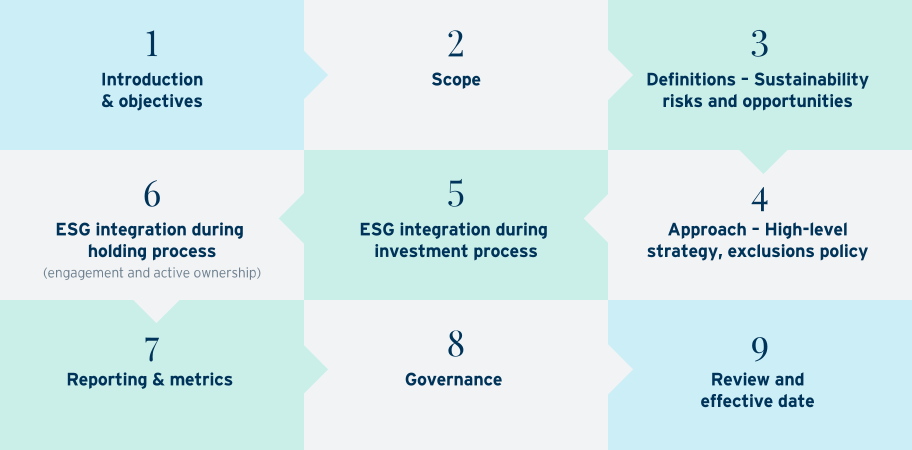
Figure 5: Possible structure of an ESG policy
Increasingly so, firms would do well to consider the future impact of ESG-related regulation as part of their ESG policy. This has come to the fore all the more since 2021 with the introduction of the Sustainable Finance Disclosure Regulation (SFDR) across Europe, which marked a significant step change in ESG for a lot of organisations by making certain aspects of reporting and certain levels of ESG performance mandatory. Please see the regulatory mapping section of this guide for more information on SFDR.
As existing ESG reporting frameworks are consolidated and as new regulation is brought in successfully, what organisations have to disclose and improve will expand. The EU Taxonomy for sustainable activities has already set out what is legally considered an environmentally sustainable investment, a valuable way of attracting investment and adding value to an organisation, which is currently set to expand to also define a social investment in addition to this. Of course, it is not always certain which regulations will come into being, as well as exactly what shape they might take; however, a good ESG policy arguably ought to consider the likely impacts of what is set to arrive in the future.
For example, certain parts of the SFDR disclosure rules (e.g., the use of the disclosure templates) are due to come into force from 1 January 2023. While it does not yet apply to the relevant organisations operating within the EU, a good ESG policy would take into account the future impact of these new obligations in terms of how, in this case, it might affect operations by changing an organisation’s ability to attract capital if it is not labelled as a sustainable investment.
In this section of the guide


Explore all sections of the guide


Reporting template and tools
ESG reporting template ESG life cycle tool SFDR tools TCFD tools Timelines


Mapping of voluntary frameworks and standards
Definitions and distinctions Who is who Scope of information

Deep dive for VCs and investors
ESG reporting from a VC perspective ESG reporting from an investor perspective