Net-Zero Asset Owner Alliance (NZAOA)


On which sustainability topics do investors have to report?
Alliance members have committed to publish targets and report on progress. Concretely:
- Members submit and publish targets within 12 months of joining.
- They also report on progress on an annual basis, both internally and publicly.
- Members shall submit their reporting on progress towards intermediate targets including on investment portfolio emission profiles and emissions reductions.
- Alliance members shall report publicly on quantitative progress every five years in line with Article 4.9 of the Paris Agreement.
Does the initiative define specific sustainability indicators?
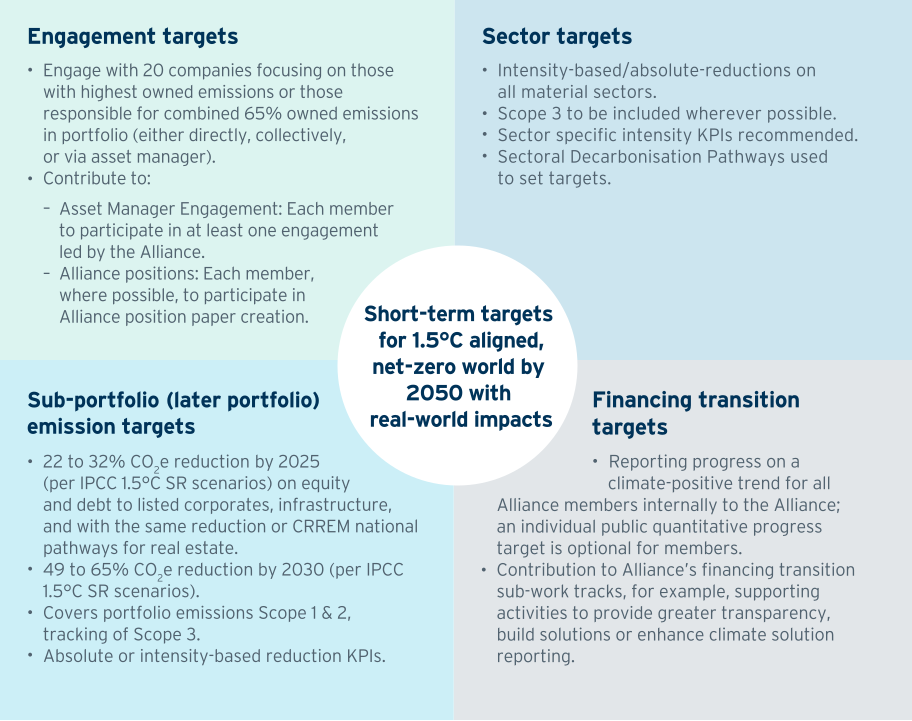
The Target Setting Protocol (2nd edition) defines a number of KPIs for the various targets:
- Sector targets: based on (1) carbon intensity of product or production (e.g., CO2e per ton of steel), (2) carbon intensity based on enterprise value (EV) or revenue; or (3) absolute emissions;
- Sub-portfolio targets: based on KPIs per asset class (e.g., carbon intensity or absolute corporate emissions for debt or equity in listed corporations, absolute emissions/carbon intensity per gross floor area and CRREM pathway alignment for real estate, absolute emissions for brownfield and lifetime emissions for greenfield infrastructure investments);
- Engagement targets: based on specific KPIs which investors should use for their reporting:
- Number of corporate engagements, aligned with the Alliance’s net-zero corporate expectations, led, or supported by the Alliance member (conducted directly by the member or by explicit request given to at least one of their asset managers).
- Number of collaborative engagements (e.g., via CA100+ or other engagement initiatives) supported by the member.
- Number of asset managers engaged based on their climate change policies and practices. This could include focused engagements by members on net-zero alignment with asset managers.
- Number of asset managers engaged collectively on climate change policies and practices.
- Number of climate position papers published by the member in line with Alliance corporate expectations.
- Number of contributions to Alliance position papers.
- Portfolio science-based target coverage in key Alliance sectors. This KPI aims to capture the progress of engagement activities via an outcome-based metric, i.e., increasing the number of net-zero or science-based commitments by portfolio companies.
- Financing transition targets: based on specific KPIs:
- Assets under management of climate solution investments (defined in the Target Setting Protocol).
- Portfolio revenue share of ‘green/brown’ activities and Taxonomy compliance (optional).
- Report on impact KPIs is recommended (e.g., avoided emissions for owned renewables).
Investor coalitions and initiatives







In this section of the guide




Explore all sections of the guide


Reporting template and tools
ESG reporting template ESG life cycle tool SFDR tools TCFD tools Timelines


Mapping of voluntary frameworks and standards
Definitions and distinctions Who is who Scope of information

Deep dive for VCs and investors
ESG reporting from a VC perspective ESG reporting from an investor perspective